How Do You Say Vacuum Cleaner In French: Quick Guide
In French, “vacuum cleaner” is aspirateur, pronounced roughly ahs-pee-rah-tuhr.
If you are asking how do you say vacuum cleaner in French, the answer is simple, but using the word naturally takes a little more care. This guide explains the correct noun, pronunciation, grammar, common phrases, regional terms, and real-life examples so you can speak with confidence.
How do you say vacuum cleaner in French?
The French word for vacuum cleaner is aspirateur. It is a masculine noun, so you usually say un aspirateur, meaning “a vacuum cleaner,” or l’aspirateur, meaning “the vacuum cleaner.”
The plural form is aspirateurs. For example:
• un aspirateur: a vacuum cleaner
• l’aspirateur: the vacuum cleaner
• des aspirateurs: vacuum cleaners
• les aspirateurs: the vacuum cleaners
The word aspirateur comes from the French verb aspirer, which means “to suck up” or “to vacuum up.” It describes a machine that pulls in dust, dirt, and other small particles.
When someone asks, “How do you say vacuum cleaner in French?” the safest answer is simply: aspirateur.
How to pronounce aspirateur
Aspirateur is pronounced approximately ahs-pee-rah-tuhr for English speakers. The final French sound is not exactly like the English word “tour,” so this spelling is only a helpful guide.
In the International Phonetic Alphabet, aspirateur is written as /as.pi.ʁa.tœʁ/. The French “r” is made in the back of the throat. Do not worry if you cannot produce it perfectly at first. Clear vowels and the correct syllable pattern matter more than a perfect accent.
Break the word into four parts:
- as
- pi
- ra
- teur
The stress in French is often lighter and more even than in English. Try not to put heavy emphasis on one syllable. Say the word smoothly, as if the sounds are connected.
A common mistake is to pronounce aspirateur like “aspirator” in English. The French ending teur sounds closer to “tuhr,” with rounded lips and no strong “or” sound.
How do you say “the vacuum cleaner” in French?
To say “the vacuum cleaner,” use l’aspirateur. The article le becomes l’ before a vowel sound, which makes the phrase easier to say.
Here are the main forms:
• un aspirateur: a vacuum cleaner
• l’aspirateur: the vacuum cleaner
• mon aspirateur: my vacuum cleaner
• ton aspirateur: your vacuum cleaner
• cet aspirateur: this vacuum cleaner
Examples include:
• J’ai acheté un aspirateur.
I bought a vacuum cleaner.
• L’aspirateur est dans le placard.
The vacuum cleaner is in the closet.
• Mon aspirateur ne fonctionne plus.
My vacuum cleaner does not work anymore.
• Cet aspirateur est très silencieux.
This vacuum cleaner is very quiet.
Because aspirateur is masculine, use le, un, mon, and ton rather than la, une, ma, and ta. This grammatical gender applies even when the machine is owned or used by a woman.
How do you say “to vacuum” in French?
French usually uses the expression passer l’aspirateur to mean “to vacuum” or “to use the vacuum cleaner.” Literally, it means “to pass the vacuum cleaner,” but the natural English meaning is “to vacuum.”
Examples:
• Je passe l’aspirateur.
I am vacuuming.
• Je dois passer l’aspirateur.
I have to vacuum.
• Elle passe l’aspirateur dans le salon.
She is vacuuming in the living room.
• Nous passons l’aspirateur chaque samedi.
We vacuum every Saturday.
The verb passer changes to match the subject:
• Je passe: I vacuum
• Tu passes: you vacuum
• Il passe: he vacuums
• Elle passe: she vacuums
• Nous passons: we vacuum
• Vous passez: you vacuum
• Ils passent: they vacuum
You may also hear aspirer, which can mean “to suck up” or “to vacuum up.” However, passer l’aspirateur is the most common everyday phrase for cleaning floors with a vacuum cleaner.
For example, “I vacuum the bedroom” is usually:
• Je passe l’aspirateur dans la chambre.
This sounds more natural than translating the English verb word for word.
Different types of vacuum cleaners in French
The basic word aspirateur covers many types of vacuum cleaners. French speakers add another word to describe the design or function.
Stick vacuum
A stick vacuum is an aspirateur-balai. Balai means “broom,” so the phrase literally suggests a broom-style vacuum.
Example:
• J’utilise un aspirateur-balai pour nettoyer rapidement la cuisine.
I use a stick vacuum to quickly clean the kitchen.
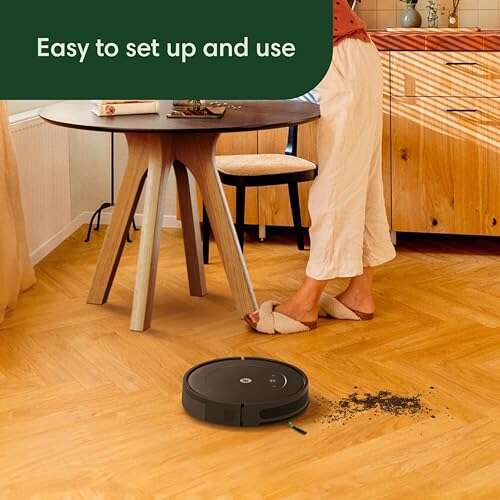
Robot vacuum
A robot vacuum is an aspirateur robot or a robot aspirateur. Both forms are understandable, although aspirateur robot is a common and clear choice.
Example:
• L’aspirateur robot nettoie le sol pendant la nuit.
The robot vacuum cleans the floor during the night.
Handheld vacuum
A handheld vacuum is an aspirateur à main. This type is useful for cars, furniture, stairs, and small spills.
Example:
• J’ai besoin d’un aspirateur à main pour la voiture.
I need a handheld vacuum for the car.
Canister vacuum
A canister vacuum is often called an aspirateur-traîneau. This refers to a vacuum with a separate canister that rolls behind the user.
Wet and dry vacuum
A wet and dry vacuum may be called an aspirateur eau et poussière. This name tells you that the machine can handle both liquids and dry dirt.
Product names can vary by country and brand. If you are shopping in France, the word aspirateur will still be the key term to look for.
Useful French phrases about a vacuum cleaner
Knowing how do you say vacuum cleaner in French is a good start, but useful phrases help you use the word in daily conversation.
• Où est l’aspirateur ?
Where is the vacuum cleaner?
• Peux-tu passer l’aspirateur ?
Can you vacuum?
• Il faut passer l’aspirateur.
We need to vacuum.
• L’aspirateur est plein.
The vacuum cleaner is full.
• Le sac de l’aspirateur est plein.
The vacuum bag is full.
• Le filtre de l’aspirateur est sale.
The vacuum cleaner filter is dirty.
• L’aspirateur fait beaucoup de bruit.
The vacuum cleaner is very loud.
• L’aspirateur ne marche pas.
The vacuum cleaner does not work.
• L’aspirateur est en panne.
The vacuum cleaner is broken.
• Je vais passer l’aspirateur dans le couloir.
I am going to vacuum the hallway.
One practical tip is to learn the phrase passer l’aspirateur as a complete unit. Treat it like the English phrase “make a decision.” Translating each word separately can lead to unnatural French.
Common mistakes English speakers make
English speakers often understand aspirateur quickly but make small grammar or pronunciation errors. These mistakes are easy to fix.
Using the wrong article
Aspirateur is masculine. Say un aspirateur, not une aspirateur.
Correct:
• J’ai acheté un aspirateur.
Incorrect:
• J’ai acheté une aspirateur.
Translating “vacuum” directly
The English sentence “I vacuum every week” does not normally become Je aspirateur chaque semaine. Aspirateur is a noun, not the usual verb for this action.
Use:
• Je passe l’aspirateur chaque semaine.
Forgetting the article
French often uses an article with household objects. Say passer l’aspirateur, not simply passer aspirateur.
Confusing aspirateur and balai
A balai is a broom. An aspirateur is a vacuum cleaner. An aspirateur-balai is a particular kind of vacuum that has a broom-like shape.