How A Vacuum Cleaner Works Step By Step: Simple Guide
A vacuum cleaner uses a motor, airflow, suction, brushes, and filters to lift and trap dirt.
Understanding how a vacuum cleaner works step by step makes it easier to choose, use, and maintain one. The basic process looks simple, but it combines air pressure, motor power, brush action, filtration, and careful airflow design. This guide explains each stage in plain language, from the moment the machine touches the floor to the moment clean air leaves the exhaust.
The basic idea behind a vacuum cleaner
A vacuum cleaner does not “pull” dirt with magic. It creates moving air. A motor spins a fan, and the fan lowers air pressure inside the machine. Air from the room then rushes toward this low-pressure area through the floor head, hose, and dust container.
This moving air carries dust, hair, crumbs, and other loose debris. The vacuum then separates the dirt from the air and stores it in a bag, bin, or water chamber. Finally, filters clean the air before it returns to the room.
A simple way to picture it is to imagine drinking through a straw. Your mouth lowers the pressure inside the straw, so liquid moves upward. A vacuum cleaner uses a motor and fan to create a similar pressure difference, but it moves air instead of liquid.
The key parts include:
• Motor: Provides the power needed to turn the fan.
• Fan or impeller: Moves air through the machine.
• Floor head: Creates the working opening near the floor.
• Brush roll: Loosens dirt and lifts hair from carpets.
• Hose and wand: Carry air and debris to the main body.
• Dust bag or dirt bin: Stores collected material.
• Filters: Trap fine particles before air leaves the cleaner.
• Seals and ducts: Keep air moving through the intended path.
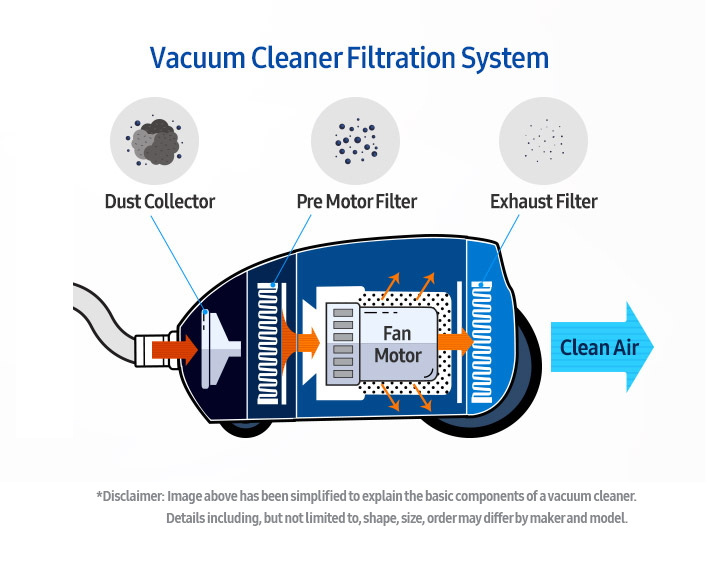
How a vacuum cleaner works step by step
The answer to how a vacuum cleaner works step by step becomes clear when you follow the path of air and dirt through the machine. Each stage has a specific job, and a problem in one stage can reduce the cleaning result.
Step 1: Electricity powers the motor
When you press the power button, electricity flows to the vacuum motor. In a corded model, power comes from a wall outlet. In a cordless model, a rechargeable battery supplies the energy.
The motor changes electrical energy into fast mechanical movement. It spins a small fan at high speed. Some motors use brushes and a commutator, while newer designs may use brushless motor technology.
The motor does not directly pick up dirt. Instead, it powers the fan that creates the airflow needed for pickup.
Step 2: The fan creates a pressure difference
The fan spins inside a sealed air path. As the fan rotates, it pushes air toward the exhaust side of the vacuum. This reduces air pressure on the intake side.
Room air then moves from the higher-pressure area outside the machine toward the lower-pressure area inside it. This pressure difference creates what people commonly call suction.
Technically, suction is not a separate force pulling dirt upward. The surrounding air pushes dirt and debris toward the lower-pressure region. Strong airflow is often just as important as high suction pressure.
Step 3: Air enters through the floor head
The cleaning head sits close to the floor. Its opening forms a narrow path where air enters. A good floor head creates a close seal without sticking too tightly to the surface.
If the head is too far from the floor, air enters from the sides. This can reduce the air speed through the opening. If the head seals completely against a smooth floor, it may become difficult to move.
Different floor heads suit different surfaces:
• Carpet heads often have rotating brushes.
• Hard-floor heads usually use soft bristles or a smooth suction channel.
• Pet tools may use stiff brush strips or rubber fins.
• Crevice tools focus airflow into a narrow opening.
Step 4: Brushes loosen embedded dirt
On carpet, a brush roll agitates the fibers. Its bristles or rubber fins reach between carpet strands and loosen dust, hair, and crumbs.
This step matters because suction alone may not remove debris trapped below the surface. The brush roll acts like a tiny rake. It lifts material toward the airflow so the air stream can carry it away.
On hard floors, a rotating brush may scatter debris if it spins too fast or has the wrong design. That is why many vacuums allow you to turn the brush roll off for wood, tile, or polished floors.
Step 5: Air carries dirt through the hose
Once debris leaves the floor, the moving air carries it through the intake channel. It may pass through a floor head, wand, hose, elbow, and internal duct.
The speed of this air depends on several factors:
• Motor power
• Opening size
• Hose length
• Duct shape
• Seal quality
• Filter condition
• Amount of dirt in the bin or bag
A small crack or loose connection can let air enter before it reaches the floor. This is called a bypass leak. It may make the motor sound normal while reducing cleaning power.
Step 6: The vacuum separates large debris
Before fine filtration begins, many vacuums separate large dirt. In a bagged vacuum, debris moves into a dust bag. In a bagless vacuum, it may enter a bin with a cyclone or baffle system.
Large particles lose speed when the airflow expands inside the container. Gravity then helps them fall into the bin. Some machines also use centrifugal force to push heavier particles outward.
This separation protects the filters. Without it, hair, sand, and crumbs would quickly block the fine filter.
Step 7: Cyclonic action separates fine dust
Many bagless vacuums use cyclonic separation. The air enters the dust chamber at an angle and begins to spin. Heavier particles move toward the outer wall and fall into the container.
Some models use one large cyclone. Others use many small cyclones. A multi-cyclonic design can remove more fine dust before the air reaches the main filter, but it still cannot replace regular filter care.
Cyclonic systems work best when the bin is not overfilled. A packed container can restrict airflow and reduce the useful action of the cyclone.
Step 8: Filters trap small particles
After larger dirt is removed, the air passes through one or more filters. These filters catch fine dust, pollen, fibers, and other small particles.
Common filter types include:
• Pre-motor filter: Protects the motor from dust.
• Foam filter: Captures larger and medium-sized particles.
• Pleated filter: Provides a large filtering surface in a small space.
• Exhaust filter: Cleans air before it returns to the room.
• HEPA filter: Captures very small airborne particles when the whole system is designed and sealed for that performance.
A filter does not work alone. The housing, seals, bag, bin, and exhaust path also matter. A vacuum with a high-grade filter but poor seals may allow dirty air to escape around the filter.
Step 9: Clean air passes the motor
In many vacuum designs, filtered air passes around or through the motor to help cool it. The motor creates heat during operation, so the airflow serves two jobs: it moves dirt and helps control motor temperature.
A blocked filter can reduce cooling airflow. This may cause the motor to run hot, produce a burning smell, shut down, or suffer long-term damage.
Never ignore a sudden change in motor sound or airflow. It may indicate a blocked filter, jammed brush roll, full bin, or internal obstruction.
Step 10: Air exits through the exhaust
After filtration and motor cooling, air leaves through the exhaust vents. Ideally, this air is cleaner than the air that entered the floor head.
Some odor may remain if the filter is dirty, the bin contains old debris, or the vacuum has absorbed moisture. A clean filter and dry dust container help prevent stale smells.
This complete sequence explains how a vacuum cleaner works step by step: power starts the motor, the fan moves air, the floor head gathers debris, the container separates dirt, filters clean the air, and the exhaust returns it to the room.
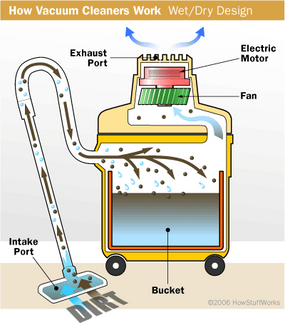
How different vacuum cleaners use the same principle
Most vacuum cleaners follow the same basic process, but their designs change the way they create airflow, store dirt, and clean surfaces.
Upright vacuums
An upright vacuum combines the motor, dust container, handle, and floor head in one body. A brush roll often sits near the bottom.
These models work well on wall-to-wall carpet because the cleaning head has a wide path. They can be heavier on stairs and less convenient for tight spaces.
Canister vacuums
A canister vacuum keeps the motor and dust container in a separate body. A flexible hose connects the body to the wand and floor tool.
This design often gives you good reach and control. It is useful for stairs, hard floors, furniture, and spaces beneath low cabinets.
Stick vacuums
Stick vacuums are slim and light. Many are cordless and use a small motor with a compact dust bin.
They are convenient for quick cleaning. However, their smaller bins and batteries may limit long cleaning sessions. Some models also lose power as the battery charge drops.
Handheld vacuums
Handheld models are made for small spills, furniture, cars, and stairs. They usually have a short airflow path and a small container.
Their compact size makes them easy to store. They are not usually the best choice for deep carpet cleaning across a whole home.
Robot vacuums
Robot vacuums use side brushes, a central brush roll, and a small suction motor. Sensors help them move around furniture and map or cover floor areas.
Most robot vacuums focus on regular surface cleaning. They may not match a full-size vacuum for deep carpet cleaning, corners, stairs, or large debris.
Central vacuum systems
A central vacuum system places the motor and collection container in a fixed location, often in a garage or utility space. Wall inlets connect to long hoses throughout the home.