How To Clean A Dyson Cordless Vacuum Cleaner: Easy Tips
For Dyson cordless vacuum owners in the United States, regular cleaning helps the vacuum pick up dirt, protect airflow, and avoid common problems such as weak suction, bad smells, and short run time. The basic process is simple: turn off and unplug the charger, empty the bin, wash only the parts marked as washable, clean the filters, remove hair from the brush bar, and let every washed part dry fully before use.
Dyson makes several cordless models, including the V-series, Outsize, Micro, Gen5, and newer versions. Their parts and filter locations can differ. Use this guide with your model’s US Dyson manual, especially before washing a filter or removing a brush bar.

What You Need Before Cleaning
Gather a soft, dry cloth, cool water, a small soft brush, scissors, and a trash bag. A clean, dry towel can help with handling the parts, but do not use heat to speed up drying.
Before you begin:
- Turn the vacuum off.
- Remove it from the charger.
- Disconnect the wand and attachments.
- Keep water away from the motor, battery, charging port, and electrical contacts.
- Work over a trash can or a washable surface.
- Check the owner’s manual for your exact Dyson model.
Do not use bleach, solvents, scented cleaners, abrasive powders, or a dishwasher. These products may damage plastic, seals, filters, or the vacuum’s finish.
A quick parts guide
| Part | Usually washable? | Cleaning method |
|---|---|---|
| Clear bin | Often, after removal | Empty, wipe, and follow the model manual |
| Pre-filter | Often | Rinse with cold water; dry fully |
| Post-filter | Often | Rinse with cold water; dry fully |
| Brush bar | Usually not soaked | Remove hair and wipe with a dry or slightly damp cloth |
| Wand | Usually not washed | Check for blockages and wipe outside |
| Motor and main body | No | Wipe with a dry cloth |
| Battery and charger | No | Keep dry and inspect for damage |
“Washable” does not mean every part can be submerged. It means Dyson has approved that specific part for the cleaning method listed for that model.
How to Empty and Clean the Dust Bin
Empty the dust bin before the dirt reaches the MAX line. A full bin can restrict airflow and allow dust to collect around the cyclone area.
- Hold the vacuum over a trash can.
- Point the bin opening into the bag.
- Press the bin-release button or pull the release lever, depending on the model.
- Let the debris drop out.
- Close the bin until it clicks.
- Wipe the outside with a soft, dry cloth.
For many Dyson cordless models, the clear bin can be removed for a deeper clean. The release method differs by model, so do not force it.
If the bin needs more cleaning
Remove the bin only as described in the manual. Wipe the inside with a damp cloth, then wipe away any remaining moisture. Some Dyson instructions allow rinsing the clear bin, while others warn against washing certain sections near the cyclone assembly.
Do not place the cyclone unit under running water unless your manual clearly says that it is washable. Water trapped in the cyclone can reach areas that are difficult to dry and may damage the vacuum.
Before reinstalling the bin, check that:
- The bin is completely dry.
- The rubber seals are clean.
- No dust blocks the opening.
- The bin locks into place.
- The release mechanism moves normally.
A clean bin should close firmly and should not leak dust around its seams.

How to Wash Dyson Cordless Vacuum Filters
Most Dyson cordless vacuums use one or more washable filters. Many models have a filter near the motor and another filter at the rear of the machine. The exact number and shape vary.
Clean the filters when the vacuum shows a filter warning, loses suction, develops a dusty smell, or has been used in a very dusty setting. Dyson commonly recommends washing filters with cold water and allowing them to dry for at least 24 hours. Follow the instructions for your model if they differ.
Step-by-step filter cleaning
- Turn the vacuum off and remove it from the charger.
- Locate each filter.
- Twist or pull the filter out as the manual shows.
- Tap loose dust into a trash can.
- Rinse the filter under cold running water.
- Gently squeeze and rinse until the water runs clear.
- Shake off excess water.
- Place the filter in a warm, well-ventilated area.
- Leave it to dry completely for at least 24 hours.
- Refit the filter securely.
Do not use soap unless Dyson specifically permits it for your model. Soap can leave residue that affects airflow or attracts dust.
Never install a damp filter. Moisture can move toward the motor and may cause electrical damage, odor, mold growth, or a loss of suction. If the filter still feels cool, heavy, or damp, it is not ready to use.
When to replace a filter
Washing does not restore every filter forever. Replace it if it:
- Remains dirty after careful washing.
- Has a tear, split, or crushed shape.
- Smells bad after complete drying.
- Does not fit tightly.
- Causes repeated filter warnings.
- Has been used for a long time and no longer restores normal airflow.
Use a genuine or clearly compatible replacement made for your Dyson model. Filter shapes and seals are not universal across the Dyson cordless range.
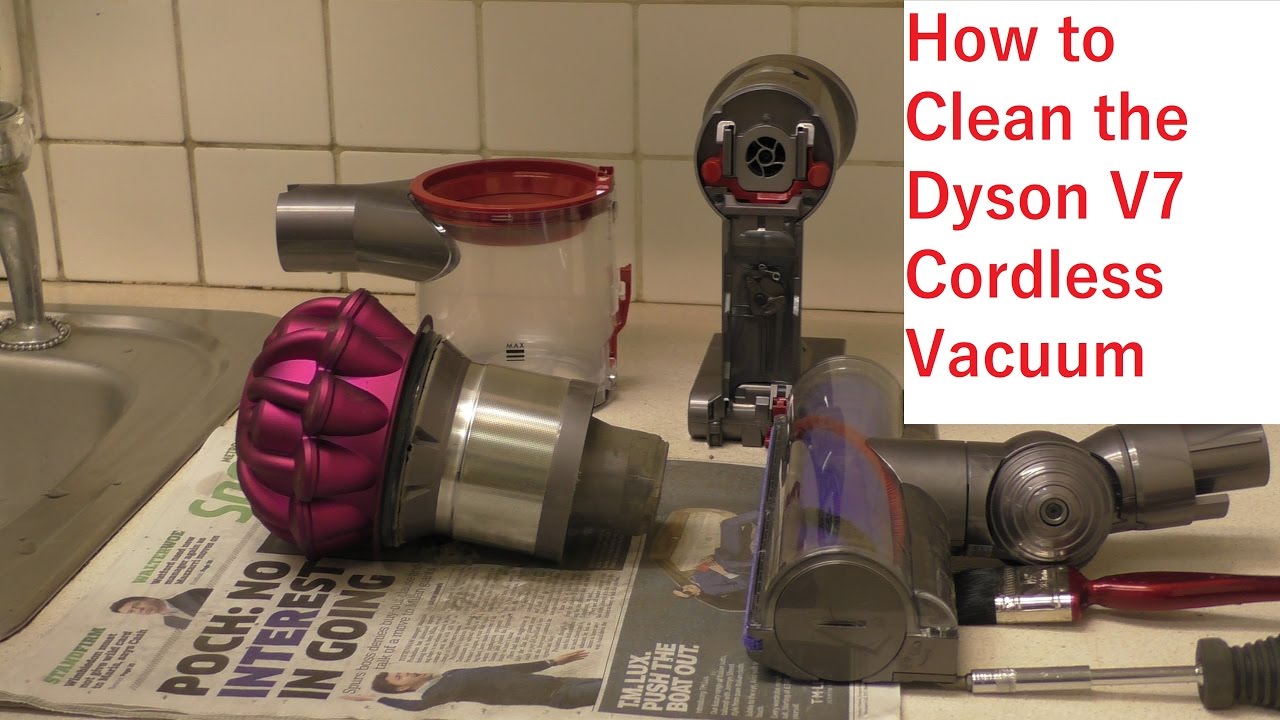
How to Clean the Dyson Brush Bar and Cleaner Head
Hair, thread, carpet fibers, and pet fur can wrap around the brush bar. This adds resistance and can cause the cleaner head to stop, pulse, or make a clicking sound.
First, turn off the vacuum and disconnect the cleaner head from the wand. Never clean a powered brush bar while it is attached to the running vacuum.
For a soft roller cleaner head
If your model has a soft roller head, follow the manual before removing the roller. Some soft rollers can be removed and washed, while the cleaner head itself must stay dry.
A safe process is:
- Remove the roller as directed.
- Pull away hair and fibers by hand.
- Use scissors to cut long strands along the roller.
- Avoid cutting the roller fabric or bristles.
- Rinse the roller only if the manual approves it.
- Dry the roller fully before reinstalling it.
- Wipe the cleaner head with a dry cloth.
Do not run a soft roller while it is wet.
For a bristle brush bar
Use a coin or the tool specified by Dyson to unlock the end cap, if your model has a removable bar. Pull out the brush bar, remove wrapped debris, and wipe it clean.
Check both ends of the bar. Hair often collects near the bearing or end cap, where it is easy to miss. Do not soak a motorized cleaner head unless the manual specifically allows it.
The brush bar is clean when it turns freely by hand, has no tight hair bands around it, and sits securely in the cleaner head.

How to Clear a Blockage
A blockage can cause low suction, pulsing, a high-pitched sound, or an automatic shutoff. Check the path from the cleaner head to the bin rather than cleaning only the visible opening.
- Turn off the vacuum.
- Remove the wand.
- Look through the wand for trapped debris.
- Check the cleaner-head neck and air inlet.
- Inspect the bin inlet and cyclone openings.
- Remove visible debris with a soft brush or blunt tool.
- Check the brush bar for wrapped hair.
- Reassemble the parts.
- Test the vacuum briefly.
Do not push sharp objects deep into the wand. A rigid tool can damage the tube or push debris farther inside.
If the vacuum still pulses after the blockage is gone, check the filter. A clogged filter can produce symptoms that look like a blocked wand. Let the filter dry fully after washing before testing the vacuum.
What different symptoms can mean
| Symptom | Common causes | First checks |
|---|---|---|
| Weak suction | Full bin, dirty filter, blockage | Empty bin, inspect filter and wand |
| Pulsing power | Airflow restriction or overheating | Check bin, filter, wand, and head |
| Brush bar stops | Hair wrap, jam, low battery | Remove hair and inspect the head |
| Dusty smell | Dirty filter or damp filter | Clean and fully dry the filter |
| Short battery run time | High-power mode, blockage, battery wear | Clear airflow and compare settings |
| Loud whine | Blockage or damaged part | Stop use and inspect the air path |
| Filter warning | Dirty or poorly fitted filter | Wash, dry, and refit the filter |
If the vacuum becomes unusually hot, smells like burning plastic, sparks, or shows battery damage, stop using it. Do not open or repair the battery yourself. Contact Dyson support or a qualified service provider.

How to Clean the Wand and Attachments
The wand and small tools collect dust even when they look clean. Remove them from the vacuum before wiping them.
Clean the wand by:
- Shaking out loose debris.
- Looking through it toward a light.
- Wiping the outside with a dry cloth.
- Using a soft brush near the ends.
- Checking for cracks or dents.
Most attachments can be wiped with a dry or slightly damp cloth. Keep powered tools dry unless Dyson specifically approves washing them. Do not push a wet cloth into an air channel.
A hair screw tool may need special attention because long fibers can wind around its internal brush. Remove the tool as directed by Dyson, pull out visible hair, and check that the small brush turns freely.
How Often Should You Clean a Dyson Cordless Vacuum?
The right schedule depends on pets, carpets, dust, construction debris, and how often you vacuum. Use this practical schedule as a starting point:
| Cleaning task | Suggested interval |
|---|---|
| Empty the bin | After each use or before the MAX line |
| Remove hair from the brush bar | Weekly, or when hair is visible |
| Inspect the wand and cleaner head | Monthly |
| Wash washable filters | About once a month, or when performance drops |
| Wipe tools and the bin exterior | Monthly |
| Inspect seals and battery area | Every few months |
Homes with pets, long hair, fine dust, or frequent carpet cleaning may need more frequent care. A schedule cannot replace the signs from the vacuum. Clean it sooner when suction falls, the motor pulses, or an odor appears.

Common Cleaning Mistakes to Avoid
The most damaging mistake is using the vacuum before its washed parts are fully dry. A filter can feel dry on the outside while holding moisture inside.
Avoid these errors:
- Running the vacuum without its required filter.
- Washing the motor or main body.
- Spraying cleaner into the cyclone or air path.
- Using hot water on filters.
- Drying filters on a radiator, heater, or in a clothes dryer.
- Reinstalling a damp brush bar.
- Forcing a bin or filter into place.
- Cutting bristles while removing wrapped hair.
- Using the vacuum to pick up liquids unless the model is designed for that use.
- Continuing to run the vacuum when it smells hot or electrical.
Also avoid vacuuming fine substances such as plaster dust, ash, or very fine construction dust unless the model and manual support that use. Fine particles can clog filters quickly and may damage the machine.
What to Do If Cleaning Does Not Fix the Problem
If the vacuum still performs poorly, repeat the checks in this order:
- Empty the bin.
- Confirm that the bin is locked in place.
- Check the wand and cleaner head for a blockage.
- Remove hair from the brush bar.
- Wash the filters.
- Wait at least 24 hours, or longer if needed, for the filters to dry.
- Refit each filter firmly.
- Charge the battery fully.
- Test the vacuum in the standard power setting.
If the motor pulses only with one attachment, that attachment may be blocked. If it pulses with every attachment, the filter or main air path is more likely to be involved.
Contact Dyson support if the vacuum continues to stop, shows a warning, overheats, makes a grinding sound, or has a damaged battery or charger. Have the model name and serial number ready. The serial number is often found on the machine, battery, or paperwork.

How to Keep a Dyson Cordless Vacuum Cleaner in Good Condition
Simple habits reduce the need for deep cleaning:
- Empty the bin before it reaches the MAX line.
- Remove long hair from the brush bar each week.
- Use the correct power mode for the job.
- Keep filters on a regular cleaning schedule.
- Store the vacuum in a dry indoor space.
- Keep the charging area free of dust.
- Do not pull the charger by its cable.
- Inspect the battery for swelling, cracks, heat, or damage.
- Use only the charger specified for the vacuum.
Cleaning improves airflow, but it cannot fix a worn battery, broken seal, damaged motor, or failed sensor. Treat cleaning as routine care, not as a substitute for repair.

Frequently Asked Questions
Can I wash the whole Dyson cordless vacuum?
No. Do not wash the motor body, battery, charger, or electrical parts. Wash only parts that the manual identifies as washable.
Can I use soap to clean a Dyson filter?
Usually, use cold water only. Soap may leave residue and is not approved for every filter. Check the instructions for your model before adding any cleaning product.
How long should a Dyson filter dry?
Allow it to dry for at least 24 hours in a well-ventilated place. Wait longer if the filter remains damp. Never use heat to dry it.
Why does my Dyson smell after cleaning?
A smell may come from a dirty filter, trapped hair, debris in the cleaner head, or a filter that was put back while damp. Clean the filter and brush bar, inspect the air path, and let all washed parts dry fully.
Can I rinse the Dyson brush bar?
It depends on the cleaner head. Some removable rollers are washable, but many motorized heads should not be soaked. Use the manual for your exact model.
Why does my Dyson stop after a few seconds?
The most common checks are the bin, filter, wand, and brush bar. A blockage or dirty filter can trigger protective shutoff. If the vacuum becomes hot or shows battery damage, stop using it and seek service.
Final Checklist
A clean Dyson cordless vacuum should have an empty bin, clear air path, freely moving brush bar, clean and dry filters, and firmly fitted parts. After cleaning, run a short test in standard mode. Listen for unusual sounds and stop if the machine overheats or smells electrical.
For the safest result, use this guide as a general process and confirm model-specific instructions in the official US Dyson manual. The key rule is simple: keep electrical parts dry, wash only approved parts, and never use a filter until it is completely dry.

Liora Pennings is a seasoned chef and kitchen enthusiast with a passion for turning everyday cooking into an effortless experience. With years of hands-on culinary expertise, she specializes in practical techniques, ingredient know-how, and smart kitchen solutions that help home cooks elevate their meals. At KitchFlair.com, Liora shares her best tips, time-saving tricks, and honest product reviews to guide readers toward a more efficient, enjoyable, and inspired cooking routine. Whether you’re a beginner or a seasoned home chef, Liora’s friendly, knowledge-packed insights make every visit to the kitchen a little easier—and a lot more delicious.