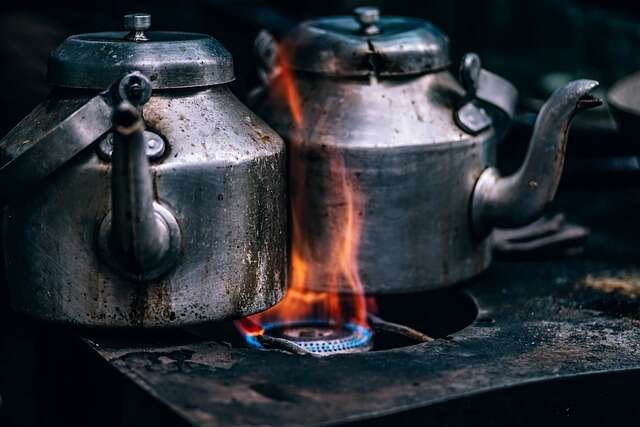
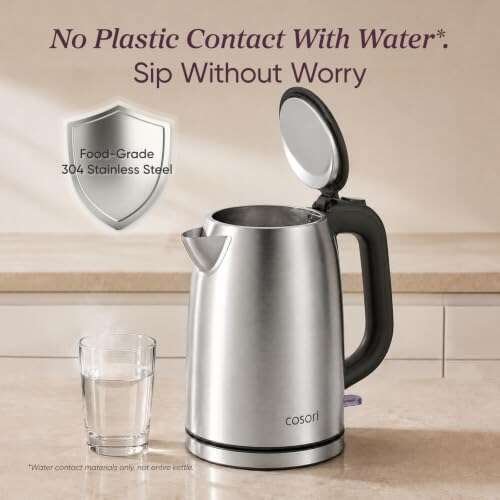
To boil water in a stovetop kettle, fill the kettle with the amount you need, place it on a matching burner, cover it with the lid, and heat it until the water reaches a full rolling boil. Turn off the burner, move the kettle carefully, and pour the water with both hands if the kettle is heavy.
This method works on gas, electric, and many induction stoves in U.S. kitchens. Use a stovetop kettle, not an electric kettle, unless the product label says it is safe for stovetop use.
What You Need Before You Start
Gather these items:
- A stovetop-safe kettle
- Clean, cold tap water or filtered water
- A working gas, electric, or induction burner
- A heat-safe surface or trivet
- An oven mitt or dry pot holder
Check the bottom of the kettle before you begin. A kettle made for induction cooking must have a magnetic, induction-ready base. Glass, ceramic, and some aluminum kettles may not work on an induction cooktop unless they contain a magnetic layer.
Make sure the kettle has no cracks, loose parts, or damaged handles. If it has a whistle spout, check that the whistle cap can open and close freely.

How to Boil Water in a Kettle on the Stove
Follow these steps for a safe and even boil.
1. Fill the kettle with the right amount of water
Open the lid and pour in only the water you need. Do not fill the kettle past its maximum-fill line.
If the kettle has no marked line, leave enough empty space for the water to expand and for steam to collect. Overfilling can cause hot water to spill from the spout or lid when the water boils.
For one mug of tea or coffee, start with about 8 to 12 fluid ounces of water. Add a little extra if you need to account for water left in the kettle or absorbed by tea.
2. Close the lid
Put the lid on firmly. A closed lid holds in heat and helps the water boil sooner.
If the lid does not fit well, check whether it is sitting at an angle. Do not use a kettle with a lid that can easily fall off during pouring.
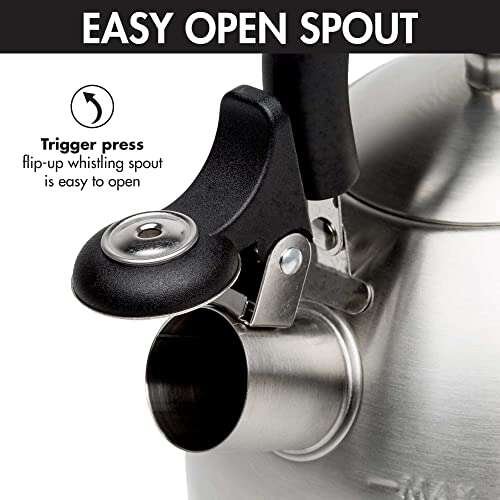
Keep the spout cap open if the kettle instructions require it. Some whistling kettles whistle only when the spout cap is closed. Follow the instructions for your kettle.
3. Place the kettle on the correct burner
Set the kettle in the center of a burner that matches the size of its base.
- On a gas stove, the flame should stay under the kettle base. It should not rise along the sides.
- On an electric coil or smooth-top stove, use a burner close to the kettle’s base size.
- On an induction stove, use an induction-compatible kettle and burner setting.
A burner that is too large can waste heat and damage some handles or exterior finishes. A burner that is too small may heat the kettle slowly.
4. Turn the burner to high
Set the burner to high to bring the water to a boil. Stay nearby while the kettle heats.
You do not need to use the highest setting if the kettle is thin, small, or prone to overheating. A strong, steady heat is enough. Once the water boils, turn off the burner promptly.
5. Watch and listen for signs of boiling
Water usually passes through several stages:
- Small bubbles form on the bottom or sides.
- Larger bubbles rise through the water.
- Steam increases.
- The water moves rapidly across the surface and produces large, steady bubbles.
A full boil is sometimes called a rolling boil. At this point, the water continues to bubble even when you stir it.
A whistling kettle may signal that the water has boiled. If your kettle does not whistle, watch for steam and strong bubbling. Do not rely only on sound, especially in a noisy kitchen.
6. Turn off the burner
Turn the burner off as soon as the water reaches the boil you need. On an electric stove, the burner may remain hot for several minutes after you switch it off.
If you use an electric coil or smooth-top stove, move the kettle to a cool burner or heat-safe surface when it is safe to do so. This stops the water from continuing to heat and reduces the chance of boiling dry.
7. Lift and pour with care
Use a dry oven mitt or pot holder. A wet cloth can transfer heat quickly and may cause a steam burn.
Keep your face, hands, and arms away from the spout. Open the lid away from you if you need to check the water because trapped steam can escape quickly.
Pour slowly into a mug, pan, or bowl. If the kettle is large or full, use both hands if the design allows it. Never pour over a child, pet, or nearby appliance.

How Long Does It Take to Boil Water on the Stove?
A small amount of water often boils in a few minutes, but the exact time depends on the volume of water, burner power, kettle material, starting temperature, lid position, and altitude.
As a rough estimate, 2 cups of room-temperature water may take about 4 to 8 minutes in a covered stovetop kettle on a strong burner. This is only a practical range, not a guaranteed time. A heavy kettle, weak burner, cold water, or high elevation can make the process take longer.
What changes the boiling time?
| Factor | Effect on boiling time |
|---|---|
| More water | Takes longer |
| Cold water | Takes longer than room-temperature water |
| Lid closed | Usually heats faster |
| Thin metal kettle | Often heats quickly |
| Heavy metal or cast-iron kettle | May heat more slowly |
| Strong burner | Usually heats faster |
| High altitude | Water boils at a lower temperature, but heating time may vary |
| Induction-compatible base | Can heat quickly when properly matched to the cooktop |
Water does not always boil at exactly 212°F. That temperature applies near sea level under standard atmospheric pressure. The boiling point falls as elevation rises.
This matters when cooking food. Water that boils at high altitude is still boiling, but it is cooler than boiling water at sea level. Food may need more cooking time. For a basic cup of tea or coffee, the practical result may be a slightly different brew.

How Much Water Should You Put in a Kettle?
Put in enough water for the drinks or cooking task, but stay below the kettle’s maximum-fill mark.
Use these amounts as simple examples:
- One 8-ounce mug: Fill with about 8 to 10 fluid ounces.
- Two mugs: Fill with about 16 to 20 fluid ounces.
- Pasta or cooking: Use the amount called for by the recipe, while staying below the kettle’s fill limit.
- A hot-water bottle or other special use: Follow that product’s instructions.
Do not boil a nearly empty kettle. The remaining water may evaporate, leaving the metal base exposed to direct heat. This can damage the kettle and create a burn or fire risk.
If you need more water than the kettle can safely hold, boil it in separate batches. Never ignore the fill line to save time.
How to Know When the Water Is Ready
The right stopping point depends on what you plan to do.
- Tea or coffee: Many people stop at a full boil, then pour the water at once. Some delicate teas taste better with water below a full boil.
- Instant oatmeal or soup: A full boil is usually suitable.
- Cooking: Follow the recipe. Some foods need a rolling boil, while others need a gentle simmer.
- Disinfection during an official water advisory: Follow instructions from your local health department or the CDC’s guidance on boiling water. A normal beverage-making boil and an emergency water-treatment instruction are not always the same task.
A few small bubbles do not mean the water has reached a full boil. Look for steady movement and large bubbles across the surface.

Stovetop Kettle Safety Tips
Hot water and steam can cause serious burns. Use these habits every time:
- Keep the kettle handle turned away from the front edge of the stove.
- Keep children and pets away from the stove while the kettle heats.
- Do not leave a boiling kettle unattended.
- Keep the handle, lid, and whistle cap free of grease.
- Use a dry oven mitt or pot holder.
- Do not touch the kettle body with bare hands, even after turning off the burner.
- Open the lid away from your face.
- Do not carry a full kettle over people, pets, cords, or clutter.
- Keep the kettle away from the edge of the counter.
- Never place a stovetop kettle in a microwave.
- Never heat an electric kettle on a stove.
- Do not use a kettle with a melted handle, damaged base, or loose lid.
If hot water spills on skin, cool the area under clean, cool running water. Do not apply ice, butter, or grease. Seek medical care for serious burns, burns on the face or hands, large burns, or burns involving a child.
The U.S. Consumer Product Safety Commission provides consumer safety information, but the care instructions for your specific kettle remain the primary guide for its use.

What to Do If the Water Will Not Boil
If the water stays hot but does not boil, check the safest and simplest causes first.
The burner is not heating
Make sure the burner is on and that the control is set high enough. On a gas stove, check for a steady flame. On an electric stove, confirm that the coil or surface is heating.
If the burner does not work, turn it off and use another burner. Do not try to repair a gas or electric cooktop while it is hot or connected to power.
The kettle does not work on induction
An induction cooktop heats magnetic cookware. Test the kettle with a refrigerator magnet. If the magnet does not attach to the base, the kettle may not work on induction.
Use an induction-ready kettle instead. Do not place a non-compatible kettle on the cooktop and assume it will eventually heat.
The kettle is overfilled
Too much water takes longer to heat and may spill when it boils. Turn off the burner, let the kettle cool, and remove some water if it is safe to do so.
Do not pour out hot water over a sink full of dishes or near your feet. Move carefully and use an oven mitt.
The lid is open
An open lid lets heat escape. Close it if the kettle design allows it, but do not force a loose or damaged lid into place.
The base is dirty or damaged
Mineral scale can build up inside a kettle, especially in areas with hard water. Scale may reduce heating efficiency and affect the taste of water.
Follow the kettle maker’s cleaning directions. Many stainless steel kettles can be cleaned with a mild vinegar-and-water solution, but some materials and finishes require different care. Rinse the kettle well after cleaning.

Common Mistakes to Avoid
Filling past the maximum line
This can make boiling water surge through the spout or around the lid. It also increases the chance of a spill when you pour.
Using a high flame that reaches the sides
A large flame does not always boil water faster. It can heat the handle, damage the kettle’s finish, and waste fuel.
Leaving the kettle empty on a hot burner
An empty kettle can overheat quickly. Turn off the burner if you realize the kettle has run dry, and let it cool before adding water.
Using a damaged kettle
A loose handle can cause a full kettle to fall. A cracked glass kettle can fail when exposed to heat. Replace damaged cookware rather than taking a chance.
Treating steam as harmless
Steam can burn skin faster than hot water because it releases heat when it condenses. Keep your face and hands away from the opening.
Boiling water again and again
Reboiling is not usually needed for ordinary tea or cooking. It can concentrate minerals slightly as water evaporates and may make the drink taste flat. Fresh water is a simple choice when taste matters.
Stovetop Kettle vs. Electric Kettle
A stovetop kettle needs a burner and works without electricity at the kettle itself. It can suit people who prefer a simple tool or who do not have an electric kettle.
An electric kettle usually switches off automatically after boiling, but it needs an outlet and must stay on a dry, stable surface. It should never be placed on a burner.
Choose a stovetop kettle when you want cookware that works on your existing range. Choose an electric kettle when automatic shutoff and quick countertop use matter more. In either case, follow the product instructions and do not exceed the fill line.
Key Takeaways
- Use a kettle made for stovetop cooking.
- Fill it below the maximum line.
- Close the lid and center the kettle on a suitable burner.
- Heat until you see a full rolling boil.
- Turn off the burner and move the kettle carefully.
- Use a dry oven mitt and protect yourself from steam.
- Never leave a boiling kettle unattended or use an electric kettle on the stove.
Frequently Asked Questions
Can you boil water in any kettle on the stove?
No. Use only a kettle labeled for stovetop use. Check that it is compatible with your cooking surface, especially if you have an induction stove. Never place an electric kettle on a burner.
Should the lid be on when boiling water?
Usually, yes. A closed lid helps hold in heat and may shorten the time needed to boil. Follow the kettle’s instructions if the lid or whistle mechanism works differently.
Is it faster to boil water with the lid on?
In most cases, yes. The lid reduces heat loss from the top of the kettle. The exact time still depends on the amount of water, burner, kettle, and starting temperature.
How do you know when a kettle is boiling if it does not whistle?
Look for large bubbles moving steadily across the surface and a strong flow of steam. A few small bubbles on the bottom mean the water is heating but has not reached a full boil.
Can you leave water in a stovetop kettle overnight?
You can, but fresh water may taste better and reduce mineral buildup. Empty and dry the kettle if the manufacturer recommends it. Never leave the kettle on a warm or active burner.
What should you do if a kettle boils dry?
Turn off the burner and do not touch the kettle until it cools. Check the kettle for warping, discoloration, cracks, or damage before using it again. Replace it if the base or handle is unsafe.
Conclusion
Boiling water in a kettle on the stove is simple: use the right kettle, add the correct amount of water, cover it, heat it on a suitable burner, and stop when the water reaches a rolling boil. The main risks come from overfilling, steam, hot handles, and leaving the kettle unattended.
For the safest result, stay near the stove, use a dry oven mitt, and pour slowly.

Liora Pennings is a seasoned chef and kitchen enthusiast with a passion for turning everyday cooking into an effortless experience. With years of hands-on culinary expertise, she specializes in practical techniques, ingredient know-how, and smart kitchen solutions that help home cooks elevate their meals. At KitchFlair.com, Liora shares her best tips, time-saving tricks, and honest product reviews to guide readers toward a more efficient, enjoyable, and inspired cooking routine. Whether you’re a beginner or a seasoned home chef, Liora’s friendly, knowledge-packed insights make every visit to the kitchen a little easier—and a lot more delicious.