How To Determine Popcorn Kettle Size: Easy Guide
To determine the right popcorn kettle size, start with your peak serving demand, not the machine’s outside dimensions. Estimate how much popcorn you need per serving, calculate the amount required during your busiest period, and then match that number to the kettle’s stated batch capacity.
In the United States, popcorn kettles are commonly described by the number of ounces of popcorn kernels they can process in one batch, such as 4-ounce, 6-ounce, 8-ounce, 12-ounce, or 16-ounce kettles. However, manufacturers may define capacity differently. Always check whether the listed size refers to kernel weight, popped output, or the complete corn-and-oil load.
What Does Popcorn Kettle Size Mean?
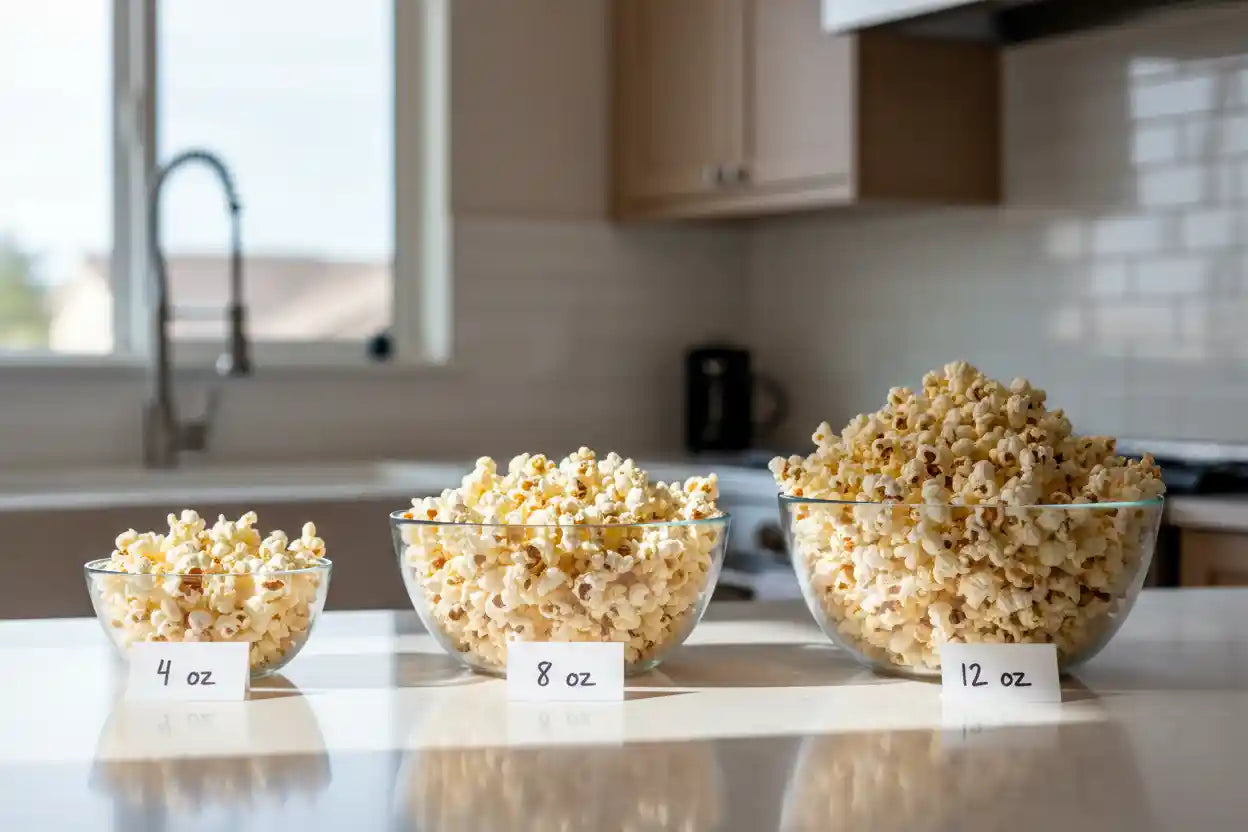
Popcorn kettle size usually refers to the amount of raw popcorn kernels the kettle can cook in one batch. It does not always describe the kettle’s physical width, depth, or total volume.
For example, a machine labeled as an 8-ounce popcorn kettle may be designed to cook about 8 ounces of kernels per batch. The actual popped volume depends on the kernel variety, moisture, oil, heat, and the manufacturer’s operating instructions.
Before comparing machines, confirm these details:
- Kernel capacity: The recommended weight of raw kernels per batch.
- Oil capacity: The amount and type of oil the kettle requires.
- Popped output: The approximate amount of finished popcorn from one batch.
- Batch time: The time needed to cook, dump, and reload the kettle.
- Machine recovery time: How quickly the kettle can return to cooking temperature.
- Recommended operating limit: The manufacturer’s maximum and minimum batch sizes.
A larger kettle is not automatically better. An oversized kettle may waste product, take longer to fill, and create stale popcorn if demand is low. A kettle that is too small may leave customers waiting during busy periods.
Start With Your Peak Demand
The best kettle size depends on how many servings you need during your busiest 15- to 30-minute period.
Daily attendance alone can mislead you. A movie theater, school event, sports venue, or church fundraiser may sell most of its popcorn during a short rush. Your kettle must handle that rush, not just the average sales for the whole day.
Gather these numbers:
- Expected peak customers
- Estimated percentage who will buy popcorn
- Average serving size
- Available selling time
- Expected batch cycle time
- A small operating buffer
Estimate the number of servings
Use this basic formula:
Expected popcorn servings =
peak customers × percentage who buy popcorn
For example, suppose 120 people may pass your concession stand during a busy 30-minute period, and 40% are expected to buy popcorn:
120 × 0.40 = 48 servings
This means you should plan for about 48 servings during that period.
If you do not have sales data, create low, medium, and high estimates. Planning with a range is safer than relying on one guess.
Estimate kernel demand
Next, determine how much popped popcorn goes into each serving. A common planning estimate is:
- Small serving: about 1 cup
- Medium serving: about 2 cups
- Large serving: about 3 to 4 cups
These are planning values, not universal standards. Scoop size, bag size, packing style, and customer expectations will change the result.
Popcorn kernels often expand to several times their original volume. For rough planning, many operators use approximately 1 ounce of kernels for about 1 quart of popped popcorn, or 4 cups. Actual output varies, so test the exact corn, oil, kettle, and serving container you plan to use.
For the 48-serving example, assume each serving contains 2 cups:
48 servings × 2 cups = 96 cups of popped popcorn
Convert cups to quarts:
96 cups ÷ 4 = 24 quarts
Using the rough planning estimate:
24 quarts ≈ 24 ounces of kernels
You would need about 24 ounces of kernels during that 30-minute rush, before adding a reserve.
Calculate the Required Batch Size
Once you know the total kernel demand, compare it with the number of batches your machine can make.
Use this formula:
Required kernel capacity per batch =
total kernel demand ÷ number of practical batches
The key word is practical. A machine may advertise a short cooking cycle, but workers also need time to:
- Remove or dump the finished popcorn
- Add fresh oil and kernels
- Close and reset the kettle
- Fill serving bags or tubs
- Handle payments and customer questions
- Clean spills or remove unpopped kernels
Example: Choosing between kettle sizes
Assume:
- Peak demand: 24 ounces of kernels
- Peak period: 30 minutes
- Realistic batch cycles: 4
- Operating reserve: 15%
First add the reserve:
24 ounces × 1.15 = 27.6 ounces
Now divide by four practical batches:
27.6 ounces ÷ 4 = 6.9 ounces per batch
A kettle rated for about 8 ounces per batch would be a reasonable starting point, provided the machine can complete four useful batches during the rush.
A 6-ounce kettle may work if the actual demand is lower or the operator can make more batches. A 12-ounce kettle may provide more capacity, but it may also produce more popcorn than you can sell before quality drops.
Use a buffer, but do not overbuild
A reserve of 10% to 20% can help cover:
- Larger-than-planned servings
- Unpopped kernels
- Short rushes
- Small delays between batches
- Product loss during handling
A large reserve is not always helpful. Freshness, storage space, labor, electrical service, and purchase cost all matter.
Match Kettle Size to Your Operation
Different U.S. settings have different demand patterns. The right capacity for a school concession stand may not suit a movie theater or a mobile event vendor.
| Operation | Typical demand pattern | Main sizing concern |
|---|---|---|
| Home use | Small and irregular | Avoid buying more capacity than needed |
| Small office or party | One short service period | Favor simple loading and easy cleanup |
| School concession stand | Sharp rush before and during events | Prioritize batch speed and operator workflow |
| Church or community event | Uneven demand | Use a buffer without creating excess waste |
| Movie theater or venue | Repeated, sustained demand | Consider recovery time and continuous production |
| Mobile concession trailer | Demand changes by event | Balance output with power, space, and transport |
| Large stadium or festival | High peak demand | Consider multiple machines or a high-output system |
For high-volume service, one very large kettle is not always the best answer. Two smaller machines may offer useful backup and allow operators to produce different flavors or products. However, two machines also require more counter space, power, cleaning, and staff attention.

Use Batch Time, Not Just Kettle Capacity
A kettle’s ounce rating tells you how much it can cook at one time. It does not tell you how much popcorn it can produce per hour.
Use this formula:
Hourly kernel capacity =
kernel capacity per batch × completed batches per hour
For example, an 8-ounce kettle that completes five real batches per hour produces:
8 ounces × 5 batches = 40 ounces of kernels per hour
This is a planning estimate. The actual figure depends on the machine, operator, corn, oil, warm-up time, and cleaning interruptions.
Calculate practical batch cycles
Use your full operating process:
Practical batch cycle =
cook time + dump time + reload time + reset time
If a kettle takes 4 minutes to cook, 1 minute to dump, and 1 minute to reload and reset:
4 + 1 + 1 = 6 minutes per batch
The theoretical maximum would be:
60 minutes ÷ 6 minutes = 10 batches per hour
In real service, the operator may not sustain 10 perfect cycles. Customer service and cleanup reduce output. Use a lower practical number when sizing the machine.
Look for the bottleneck
Your kettle may not be the slowest part of the operation. Common bottlenecks include:
- One person taking orders and operating the machine
- Limited counter space
- Slow bagging or scooping
- Insufficient holding space
- Weak electrical service
- A machine that needs frequent cooling
- Cleaning between batches
- Long lines at payment
If the machine can produce more popcorn than your staff can serve, increasing kettle size may not improve sales.
Compare Common Kettle Sizes
The table below gives general planning guidance. It is not a substitute for the specific manual because manufacturers use different capacity and output ratings.
| Kettle rating | Approximate kernel load | Approximate popped volume using a 1-quart-per-ounce estimate | Suitable use |
|---|---|---|---|
| 4 ounces | 4 ounces | About 4 quarts | Home, office, small gatherings |
| 6 ounces | 6 ounces | About 6 quarts | Small events and light concession use |
| 8 ounces | 8 ounces | About 8 quarts | Moderate event or school sales |
| 12 ounces | 12 ounces | About 12 quarts | Busy concession service |
| 16 ounces | 16 ounces | About 16 quarts | High-volume or sustained service |
Actual output may be lower or higher. Kernel size, moisture, oil, kettle design, and serving method all affect the result.
If your machine’s manual provides a tested output figure, use that figure instead of the rough expansion estimate.
A simple capacity guide
As a broad starting point:
- Choose 4 to 6 ounces for occasional use and small groups.
- Choose 6 to 8 ounces for modest event sales.
- Choose 8 to 12 ounces when demand arrives in repeated rushes.
- Consider 12 to 16 ounces or multiple machines for sustained high-volume service.
Treat these ranges as a first screen, not a final purchase rule.

Check the Machine’s Physical and Utility Requirements
A kettle can be the right size on paper and still be unsuitable for your location.
Before buying, check:
Counter and clearance space
Measure:
- Machine width
- Machine depth
- Total height
- Door and service-panel clearance
- Space for bags, scoops, oil, kernels, and waste
- Room for the operator’s hands and movement
Do not measure only the footprint. A tall machine may need extra overhead clearance for cleaning or kettle access.
Electrical requirements
Read the machine’s data plate and manual. Confirm:
- Voltage
- Amperage
- Plug type
- Circuit requirements
- Whether the outlet is dedicated
- Whether a generator or mobile power system can support it
Do not use an adapter or extension cord unless the manufacturer permits it and the electrical setup is suitable. For commercial or temporary installations, ask a qualified electrician or the event site manager to verify the circuit.
Heat and ventilation
Popcorn machines produce heat, steam, and oil fumes. Place the machine where heat will not damage nearby materials or create a hazard. Follow the manufacturer’s spacing and ventilation instructions.
Transport needs
For mobile events, account for:
- Cart or trailer space
- Door widths
- Weight
- Secure storage during transport
- Access to power
- Protection from rain and wind
- Setup and teardown time
A smaller machine that arrives on time and operates reliably may be more useful than a larger machine that is difficult to move.
Confirm What the Manufacturer’s Capacity Rating Includes
Manufacturers do not always use kettle ratings in the same way. One company may list the kernel load, while another may emphasize finished output or total batch ingredients.
Before comparing models, find the manual or specification sheet and verify:
- The rated kernel load
- The recommended oil amount
- The expected popped output
- The cooking time
- The minimum and maximum batch size
- Whether the kettle is intended for continuous commercial use
- The cleaning and maintenance requirements
- The electrical rating
- The warranty conditions
- Any required accessories
Do not fill a kettle based only on its physical appearance. Overloading can cause uneven popping, spills, scorching, excess unpopped kernels, or damage to the heating system.
Likewise, do not assume that a kettle rated for 8 ounces should always be operated at exactly 8 ounces. Some machines require a smaller first batch, a warm-up batch, or a specific oil-to-corn ratio.
Test Your Actual Serving Size
The most reliable way to refine your estimate is to run a controlled test with the exact supplies you will use.
Record:
- Kernel weight
- Oil volume
- Batch start and finish time
- Popped volume
- Number of filled bags or tubs
- Unpopped kernels
- Product left over after 15, 30, and 60 minutes
- Staff time needed per batch
Use a kitchen scale for kernels. Use the same serving scoop and container that customers will receive.
Signs that your kettle is too small
Your kettle may be undersized when:
- Customers wait through multiple cycles
- The operator cannot keep up during predictable rushes
- The machine runs continuously without a recovery period
- Staff skip cleaning or safe handling steps
- You regularly run out of popcorn before the rush ends
- The line grows even though the operator works efficiently
Signs that your kettle is too large
The kettle may be oversized when:
- Popcorn sits for long periods
- You discard large amounts after service
- The machine takes too long to sell one batch
- You cannot use the minimum batch without waste
- The machine takes too much counter or storage space
- Its electrical demand exceeds the available circuit
Freshness matters. Producing more popcorn than you can sell may raise waste rather than improve service.
Common Popcorn Kettle Sizing Mistakes
Choosing by machine size alone
A large cabinet does not always contain a large kettle. Compare the actual rated kernel load and tested output.
Using total attendance instead of peak demand
If 300 people attend an event but only 60 buy popcorn during the busiest 20 minutes, the 60-person rush controls your kettle choice.
Ignoring the operator
One person may not be able to cook, scoop, take payment, restock, and clean at the same speed as a dedicated machine operator.
Treating estimated output as guaranteed
The 1-ounce-to-1-quart planning estimate is useful for initial math, but it is not a promise. Test your own ingredients and machine.
Filling the kettle above the manual’s limit
More kernels do not always mean more usable popcorn. Overfilling can lead to poor popping, spills, scorching, or equipment damage.
Forgetting holding time
Popcorn quality declines as it sits. A large kettle is less useful if each batch remains in the cabinet longer than your quality target.
Ignoring power requirements
A kettle that cannot run on the available circuit will not meet its advertised output. Verify the electrical load before purchase or rental.
Buying one oversized machine for backup
A second smaller machine may provide better redundancy than one very large machine, but only if you have enough power, staff, and space.
A Quick Kettle Size Worksheet
Use this worksheet before comparing machines.
Peak customers: __________________

Expected percentage buying popcorn: __________ %

Expected servings:
peak customers × purchase rate = __________ servings

Average popcorn per serving: __________ cups

Total popped popcorn:
servings × cups per serving = __________ cups

Total popped popcorn in quarts:
cups ÷ 4 = __________ quarts

Estimated kernel demand:
quarts × approximately 1 ounce = __________ ounces

Operating reserve:
estimated demand × 1.10 to 1.20 = __________ ounces

Practical batches during peak period: __________

Required kettle load:
reserve demand ÷ practical batches = __________ ounces per batch
Then compare the result with the manufacturer’s published specifications.
Example worksheet
Suppose your event has:
- 150 peak customers
- 35% expected popcorn buyers
- 2 cups per serving
- Four practical batches during the rush
- A 15% reserve
Calculation:
150 × 0.35 = 52.5 servings
52.5 × 2 cups = 105 cups
105 ÷ 4 = 26.25 quarts
26.25 × 1 ounce = 26.25 ounces of kernels
26.25 × 1.15 = 30.2 ounces with reserve
30.2 ÷ 4 batches = 7.55 ounces per batch
A machine rated around 8 ounces per batch would meet this estimate. You would still need to confirm that the machine can complete four practical batches during the rush and that its electrical and space requirements fit the location.

Frequently Asked Questions
Is a bigger popcorn kettle always better?
No. A larger kettle helps when demand is high and sustained, but it can create waste during slow periods. Choose the smallest capacity that can meet peak demand with a practical reserve.
How many people can an 8-ounce popcorn kettle serve?
That depends on serving size and actual popped output. Using the rough estimate of 1 quart, or 4 cups, per ounce, an 8-ounce batch may produce about 32 cups. At 2 cups per serving, that is roughly 16 servings. Actual results vary, so test the machine with your ingredients.
What is the difference between kettle size and popcorn machine size?
Kettle size describes the batch capacity inside the machine. Machine size describes the full cabinet or appliance footprint. A larger cabinet may include more storage or display space without having a larger kettle.
Should I choose one large kettle or two smaller kettles?
Choose one large kettle when demand is steady and space, power, and staffing are limited. Consider two smaller machines when you need backup, separate products, or flexible output. Compare total power use, cleaning time, cost, and operator capacity.
Can I use a smaller batch in a large kettle?
Only if the manufacturer allows it. Some kettles need a specific minimum amount of oil and kernels for proper heating and coverage. Follow the operating manual rather than guessing.
How often should I test my popcorn yield?
Test when you change the machine, kernels, oil, serving scoop, or container. Also retest if you notice more waste, smaller servings, slower popping, or changes in customer demand.
Final Recommendation
To determine popcorn kettle size, calculate your peak servings, convert those servings into estimated kernel demand, divide the demand by the number of practical batches, and add a modest reserve. Then verify the result against the manufacturer’s rated kernel load, batch time, electrical requirements, and minimum operating limits.
For many small U.S. events, a kettle in the 6- to 8-ounce range may be a practical starting point. Busy venues may need 8 to 16 ounces or multiple machines, but the correct choice depends on actual rush demand, staff capacity, freshness targets, and available power.
The next step is simple: measure one real batch with your planned kernels, oil, scoop, and serving bag. That test will give you a more useful answer than the kettle label alone.

Liora Pennings is a seasoned chef and kitchen enthusiast with a passion for turning everyday cooking into an effortless experience. With years of hands-on culinary expertise, she specializes in practical techniques, ingredient know-how, and smart kitchen solutions that help home cooks elevate their meals. At KitchFlair.com, Liora shares her best tips, time-saving tricks, and honest product reviews to guide readers toward a more efficient, enjoyable, and inspired cooking routine. Whether you’re a beginner or a seasoned home chef, Liora’s friendly, knowledge-packed insights make every visit to the kitchen a little easier—and a lot more delicious.