Introduction
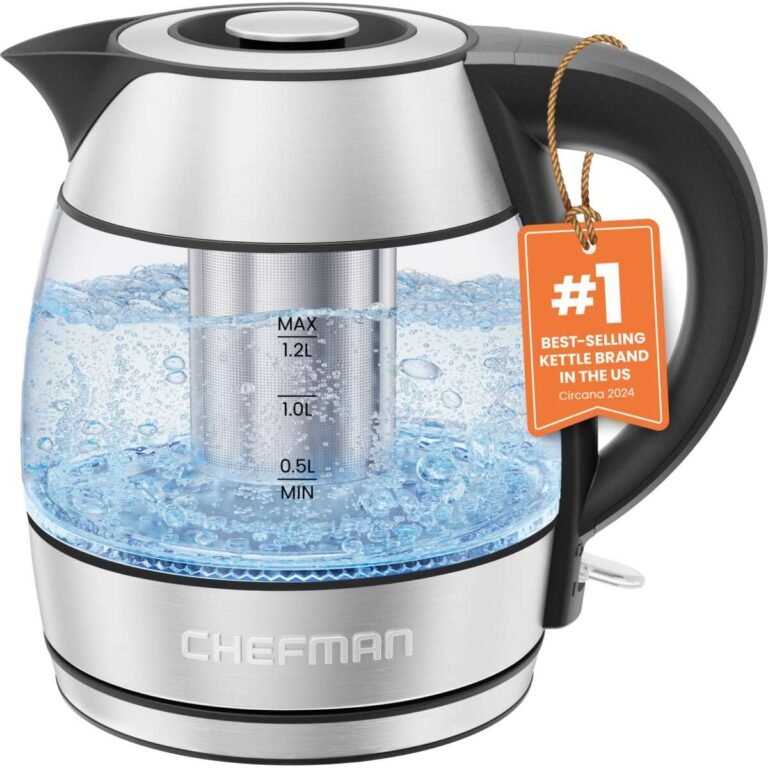
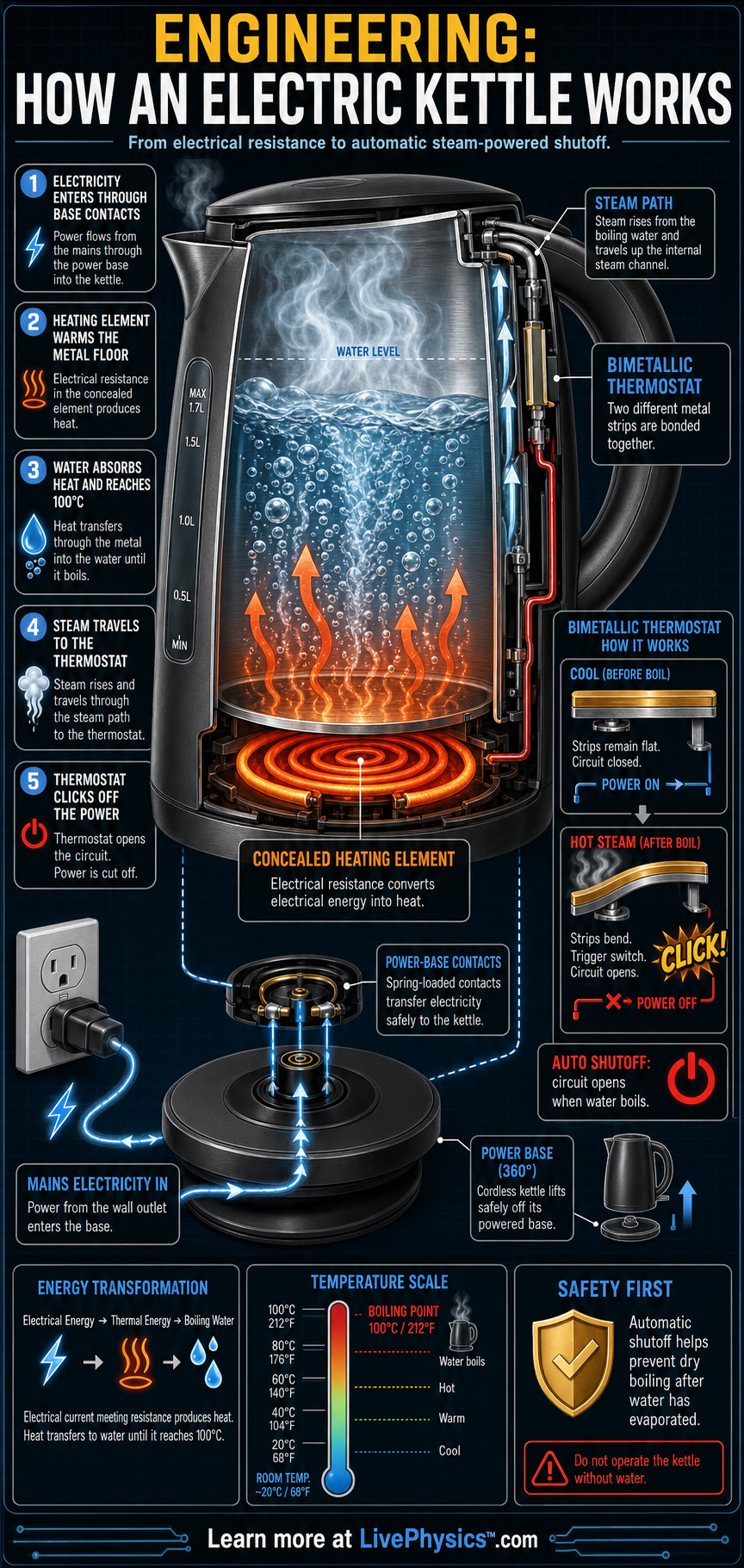
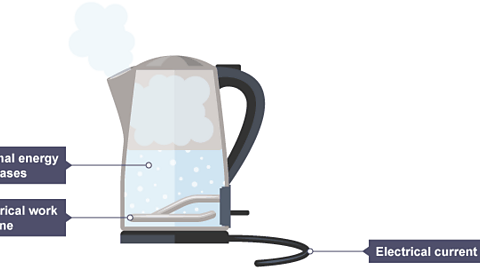
In a U.S. kitchen, an electric kettle turns electrical energy into heat. Most models use a metal heating element. When current flows through that element, electrical resistance produces heat. The heat passes into the water until the water reaches its boiling point.
For a typical U.S. electric kettle, the process uses a 120-volt, 60-hertz outlet. A thermostat or steam sensor then switches the kettle off when the water boils. This simple process brings together electrical resistance, heat transfer, convection, phase change, and automatic control.
The short answer: how does a kettle work?
A kettle works through Joule heating.


When electric current passes through a resistant metal element, the element heats up. That heat moves into the water. Warm water rises while cooler water falls, creating convection currents that spread heat through the kettle.
When the water reaches its boiling point, several things happen:
- Water at the bottom turns into steam.
- Steam rises into the lid or sensor area.
- A thermostat detects the rapid rise in temperature.
- The thermostat opens the circuit.
- The heating element stops receiving power.
At normal atmospheric pressure, water boils at about 212°F (100°C). The exact temperature can change with altitude and air pressure.
A kettle does not heat water by creating heat from nowhere. It changes electrical energy into thermal energy, then transfers that heat to the water.
The main physics inside an electric kettle
the main physics involves electrical resistance, heat capacity, convection, and boiling.
1. Electrical resistance creates heat
The heating element is often made from a metal alloy with useful electrical resistance. When current passes through it, electrical energy becomes heat.
The basic power equation is:
[
P = VI
]
Where:
- (P) is power in watts
- (V) is voltage in volts
- (I) is current in amperes
A 1,500-watt kettle connected to a 120-volt U.S. outlet draws about:
[
I = \frac{P}{V} = \frac{1500}{120} = 12.5\text{ amps}
]


The heating power can also be written as:
[
P = I^2R
]
Here, (R) is electrical resistance. This is why a resistant heating element becomes hot when current flows through it.
2. Water needs energy to get hotter
Water has a high specific heat capacity. It takes about 4,186 joules of energy to raise 1 kilogram of water by 1°C.
The heat needed can be estimated with:
[
Q = mc\Delta T
]
Where:
- (Q) is heat energy in joules
- (m) is the mass of water in kilograms
- (c) is water’s specific heat capacity
- (\Delta T) is the temperature increase in degrees Celsius
For a hypothetical 1-liter fill, the water mass is close to 1 kilogram. If the starting temperature is 68°F (20°C), the temperature rise to boiling is about 80°C.
[
Q = 1 \times 4186 \times 80
]
[
Q \approx 335,000\text{ joules}
]
That is about 0.093 kilowatt-hours of heat energy. A real kettle uses more because some heat escapes into the air, the container, and the lid.
3. Convection spreads the heat
Water does not heat evenly by conduction alone. Instead, it mainly uses convection.
Water near the heating element warms first. Warm water expands slightly and becomes less dense, so it rises. Cooler, denser water moves downward to replace it. This creates a circulating flow inside the kettle.
The flow helps prevent hot spots and moves heat through the full volume of water. Near boiling, bubbles of water vapor also carry heat upward.
4. Boiling is a phase change
Boiling is more than “very hot water.” It is a phase change from liquid water to water vapor.


Before boiling, added energy mainly raises the water’s temperature. At the boiling point, added energy helps break the attractions between water molecules so liquid water can become steam.
This energy is called the latent heat of vaporization. It is why boiling water can keep receiving heat without rising much above its boiling temperature at normal pressure.
A kettle usually switches off soon after boiling begins. It does not need to turn all the water into steam.
What parts make a kettle work?
An electric kettle uses a small number of parts, but each has a clear job.
| Part | Main job | Physics involved |
|---|---|---|
| Heating element | Produces heat | Electrical resistance |
| Kettle body | Holds water and limits heat loss | Thermal insulation |
| Base and contacts | Transfer electrical power | Circuit connection |
| Thermostat | Opens the circuit at the end | Temperature control |
| Steam channel or sensor | Detects boiling | Steam and heat transfer |
| Lid | Keeps heat and steam contained | Convection and vapor flow |
| Water-level marks | Set the fill amount | Volume and mass |
| Dry-boil protection | Stops heating without enough water | Temperature sensing |
Many modern kettles use a concealed heating element under a metal plate. This design keeps the element away from direct contact with the water and makes cleaning easier.
The base often supplies power through spring-loaded or circular contacts. This lets the user lift the kettle without unplugging a cord from the wall.
The thermostat
The thermostat is a temperature-controlled switch. In many kettles, it uses a bimetal strip or a similar temperature-sensitive part.
A bimetal strip contains two metals that expand at different rates. As it heats, it bends. At a set point, it moves the switch and breaks the electrical circuit.
Some kettles sense steam instead. As boiling water sends steam through a small channel, the steam heats a sensor. That sensor then triggers the switch.
Dry-boil protection
A kettle should not run empty. Without water to absorb heat, the element and nearby parts can become much hotter than normal.
Dry-boil protection detects an unsafe temperature or an abnormal heating condition. It then cuts power. This feature reduces risk, but it does not make an empty kettle safe to operate on purpose.

How long should a kettle take to boil?
Boiling time depends on the water volume, starting temperature, kettle power, altitude, and heat loss.
A useful estimate is:


[
t = \frac{mc\Delta T}{P\eta}
]
Where:
- (t) is time in seconds
- (m) is water mass in kilograms
- (c) is specific heat capacity
- (\Delta T) is the temperature rise
- (P) is kettle power in watts
- (\eta) is efficiency as a decimal
For a hypothetical 1-liter fill:
- Water mass: 1 kg
- Starting temperature: 68°F (20°C)
- Final temperature: 212°F (100°C)
- Temperature rise: 80°C
- Kettle power: 1,500 W
- Assumed efficiency: 85%
[
t = \frac{1 \times 4186 \times 80}{1500 \times 0.85}
]
[
t \approx 263\text{ seconds}
]
That is about 4.4 minutes.
This is an estimate, not a fixed promise. A smaller amount may boil in less time. Cold water, a cold kettle, a loose lid, or a high elevation may change the result.
The power rating matters, but it is not the only factor. A 1,500-watt kettle can boil more water than a 1,000-watt kettle in less time, all else being equal. However, the higher-power model also draws more current while it runs.

Why does water boil at different temperatures?
At sea level, water boils at about 212°F. At higher elevations, air pressure is lower. Water can then form vapor more easily, so it boils at a lower temperature.
For example, water boils below 212°F in high-elevation areas of the western United States. The kettle may still shut off normally because it detects steam or a rapid temperature change, not because it always reaches 212°F.
This creates an important distinction:
- Boiling temperature depends on air pressure.
- Kettle shutoff depends on the kettle’s sensor and design.
At altitude, water may boil sooner by temperature but still take longer to heat if the air is colder or the starting water is colder. The final water temperature may also be lower, which can affect coffee, tea, pasta, and other cooking tasks.

How is an electric kettle different from a stovetop kettle?
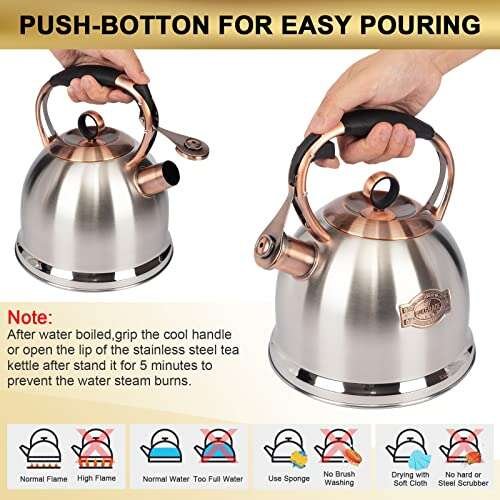
An electric kettle makes heat inside the appliance. A stovetop kettle receives heat from a burner.


With a stovetop kettle:
- The burner heats the kettle base.
- The base transfers heat to the water.
- Convection moves heat through the water.
- Steam may produce a whistle or lift a valve.
With an electric kettle, the heating element is close to the water. This usually reduces the number of heat-transfer steps.
The basic physics is the same in both designs: energy enters the water, the water circulates, and boiling creates steam. The main difference is the heat source and the control system.
A stovetop kettle may continue heating unless someone turns off the burner. An electric kettle usually has automatic shutoff. Neither design should be left unattended when damaged, unstable, or used in a way the manufacturer does not allow.

What affects kettle efficiency?
A kettle uses less energy when it heats only the amount of water needed.
The biggest factors are:
- Water volume: More water requires more energy.
- Starting temperature: Cold water needs more energy than warm water.
- Heat loss: Heat escapes through the body, lid, base, and steam.
- Kettle condition: Mineral scale can add resistance to heat transfer.
- Lid position: A closed lid usually reduces heat loss.
- Power and time: Higher power can shorten heating time but does not remove the energy needed to heat the water.
For the same water volume and temperature rise, the ideal heat requirement is nearly the same. A faster kettle does not break the laws of physics. It supplies energy at a higher rate.
A simple way to reduce wasted energy is to measure the water before filling the kettle. Do not fill it to the maximum line for one cup. Keep the lid closed during heating, and descale the kettle according to its instructions.

Is an electric kettle safe?
An electric kettle is generally safe when its electrical parts stay dry and the kettle is used within its marked limits. It still combines water, heat, steam, and household electricity, so basic care matters.
Follow these safety rules:
- Keep the plug, cord, base, and outlet dry.
- Do not immerse the kettle, base, cord, or plug in water.
- Fill only between the minimum and maximum marks.
- Keep the lid closed while heating unless the manual says otherwise.
- Do not touch the metal body or steam outlet during or after boiling.
- Pour slowly to avoid hot-water burns.
- Place the base on a stable, heat-resistant surface.
- Stop using the kettle if the cord, plug, housing, or base is damaged.
- Unplug it before cleaning.
- Use a grounded outlet when the product requires one.
- Do not use an extension cord unless the manufacturer permits it and the cord is rated for the appliance’s load.
A 1,500-watt kettle on a 120-volt circuit draws about 12.5 amps. That is a substantial load for a small appliance. Do not overload a power strip or share a weak circuit with several high-power appliances.
If the kettle trips a circuit breaker, smells like burning plastic, sparks, leaks, or stays on after boiling, unplug it when safe and stop using it. Electrical repairs should be handled by a qualified technician or replaced with a properly certified appliance.

Common kettle problems and the physics behind them
The kettle does not turn on
Check the outlet, the plug, the base connection, and the water level. Some kettles will not operate below their minimum fill line.
If another appliance also fails on the same outlet, the problem may be the circuit rather than the kettle. If the outlet works but the kettle remains dead, the switch, thermal fuse, thermostat, or base contacts may have failed.
The kettle turns off too soon
The steam channel or sensor may be blocked. Mineral scale can also change how heat reaches the thermostat.
Unplug the kettle, let it cool, and clean it according to the manual. Do not open the appliance unless you are qualified to work on mains-powered equipment.
The kettle does not turn off
Turn off power at the outlet or unplug the kettle if you can do so safely. A failed thermostat or switch can create a serious overheating risk.
Do not continue using the kettle simply because it still boils water. Automatic shutoff is a safety control, not just a convenience.
The water tastes unusual
New materials, mineral deposits, cleaning residue, or water quality can affect taste. Wash and rinse the kettle as directed. If the taste remains, check the manufacturer’s cleaning instructions and your local water information.
The kettle is noisy
A low rumble or clicking sound can be normal. Bubbles form near the hot element, collapse, and move through the water. Hard-water scale can make the sound louder by creating rough surfaces and uneven heating.
Noise combined with burning smells, leaks, or electrical faults is not normal.

Frequently asked questions
Does a kettle heat water from the bottom first?
Usually, yes. The heating element is commonly at or beneath the bottom of the water chamber. Water near that surface warms first, then convection carries heat upward and around the kettle.
Why does a kettle switch off when the water boils?
Boiling creates steam. Steam heats a sensor or thermostat, which opens the electrical circuit and stops the heating element. Some designs also respond to the rapid temperature rise near the end of heating.
Does boiling water in a kettle use less energy than boiling it on a stove?
It can, but the answer depends on the kettle, stove, cookware, amount of water, and heat loss. An electric kettle places the heating element close to the water. A stove transfers heat through a burner and pan, which can lose more heat to the room. The fairest comparison uses the same water volume and starting temperature.
Can a kettle boil water above 212°F?
At normal atmospheric pressure, liquid water generally does not remain at a higher boiling temperature in an open kettle. Steam pressure, altitude, and sealed systems can change the conditions. A standard household kettle is not a pressure cooker and should never be sealed while heating.
Why should you not boil more water than you need?
The kettle must supply heat to every gram of water. Extra water therefore increases energy use and heating time. Measuring the amount you need is the simplest efficiency step.
Final answer
A kettle works by using electrical resistance to make heat, then transferring that heat to water. Convection spreads the heat through the kettle. When the water reaches boiling, steam activates a thermostat or sensor that cuts power.
The key equations are:
[
P = VI
]
for electrical power, and:
[
Q = mc\Delta T
]
for the heat needed to raise the water’s temperature.
For practical use, fill the kettle with only the water you need, keep the lid closed, remove mineral scale, and stop using the appliance if its electrical safety controls fail. That simple routine follows the same physics that makes the kettle fast, useful, and safe.

Liora Pennings is a seasoned chef and kitchen enthusiast with a passion for turning everyday cooking into an effortless experience. With years of hands-on culinary expertise, she specializes in practical techniques, ingredient know-how, and smart kitchen solutions that help home cooks elevate their meals. At KitchFlair.com, Liora shares her best tips, time-saving tricks, and honest product reviews to guide readers toward a more efficient, enjoyable, and inspired cooking routine. Whether you’re a beginner or a seasoned home chef, Liora’s friendly, knowledge-packed insights make every visit to the kitchen a little easier—and a lot more delicious.