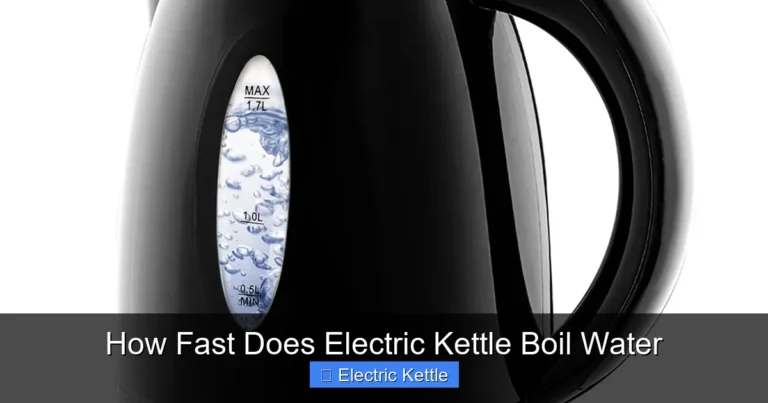
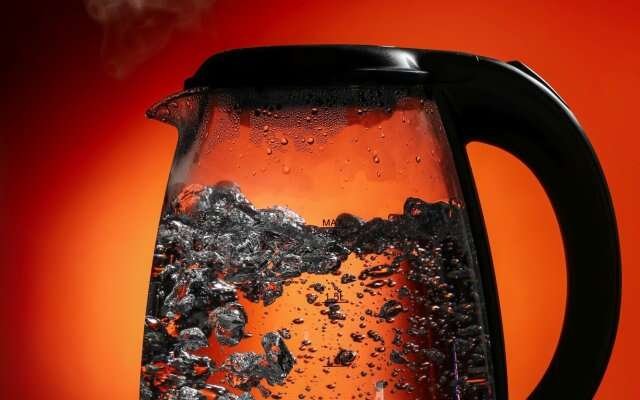
In the United States, an electric kettle uses electricity to heat water until it reaches its boiling point—about 212°F (100°C) at sea level. A heating element transfers energy to the water. As the water gets hot, it moves in currents. When enough water reaches its boiling point, water vapor bubbles form throughout the liquid and rise to the surface.
The kettle then shuts off when a thermostat senses steam or a rapid rise in temperature. A stovetop kettle works in much the same way, but a burner supplies the heat instead of an electric heating element.

The short answer: How does a kettle boil water?
A kettle boils water in five basic steps:


-
Energy enters the kettle.
Electricity powers a heating element, or a stove heats the kettle base. -
The water warms from the bottom up.
Water near the heat source becomes warmer and less dense. -
Convection moves the water.
Warm water rises while cooler water falls. This creates circulating currents. -
The water reaches its boiling point.
At normal sea-level pressure, water boils at about 212°F. -
Steam triggers the shutoff.
In many electric kettles, rising steam activates a thermostat that cuts power.
Boiling is not simply “hot water making bubbles.” Small bubbles can appear before boiling because dissolved air escapes from the water. True boiling begins when vapor bubbles form inside the water and continue rising to the surface.
What happens inside an electric kettle?
An electric kettle turns electrical energy into heat through a metal heating element. Most modern kettles use a concealed element beneath a metal plate, although some older designs expose the element directly to the water.
When you switch on the kettle, current flows through the heating element. The element has electrical resistance, so it becomes hot. This process is called resistive heating.
The hot element transfers heat to the kettle base. The base then transfers heat to the water. The water does not heat at the same rate in every part of the kettle. The water closest to the base warms first.
Convection spreads the heat
Warm water expands slightly. This makes it less dense than cool water, so it rises. Cooler, denser water sinks toward the bottom. This repeated motion is called convection.
Convection helps distribute heat through the kettle. It also explains why water can heat fairly evenly even though the heat enters mainly at the bottom.


The flow often becomes stronger near the end of the heating cycle. You may see small streams, swirls, or bubbles moving through the water before it reaches a full boil.
Bubbles do not always mean boiling
Water contains small amounts of dissolved gases, such as oxygen and carbon dioxide. As the water warms, these gases become less soluble and leave the water. This can create tiny bubbles on the sides or bottom of the kettle.
These early bubbles are not usually water vapor. They are mostly dissolved air. A rolling boil starts later, when the water itself changes into vapor inside the liquid.
Why steam appears near the end
At the boiling point, some water molecules have enough energy to escape as gas. This gas is water vapor.
The white cloud you see above a kettle is not pure water vapor. Pure water vapor is invisible. The visible cloud forms when hot vapor cools in the air and condenses into tiny liquid droplets.

How does a stovetop kettle work?
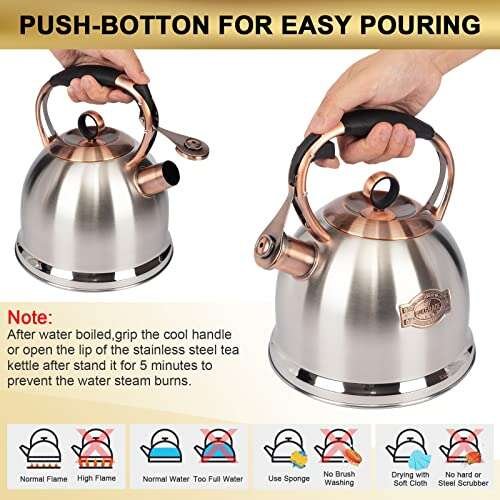
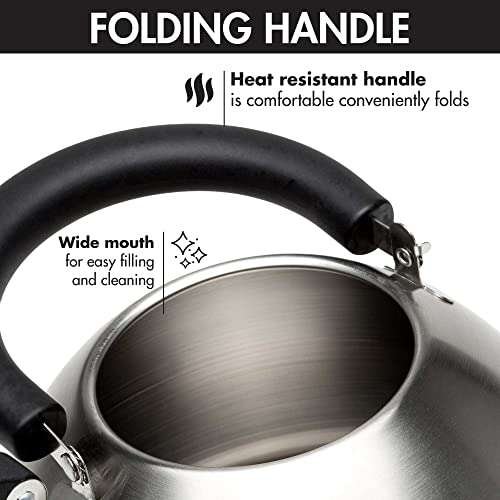
A stovetop kettle uses a burner to heat its base. The base transfers heat to the water, and convection spreads that heat through the kettle.
Many stovetop kettles have a whistle. The whistle does not detect the temperature directly. Instead, steam passes through a small opening and makes the air vibrate. This creates the familiar sound.
The whistle usually indicates that the water is producing a large amount of steam. It does not prove that every part of the kettle is at exactly the same temperature. It also does not mean the kettle is safe to leave unattended.
A stovetop kettle may take longer than an electric kettle, depending on:
- Burner power
- Kettle material
- Amount of water
- Lid position
- Starting water temperature
- Heat loss to the room
- Whether the kettle fits the burner well
A covered kettle usually heats faster because the lid reduces heat loss. However, steam and hot surfaces can cause serious burns, so use the handle and keep your face and hands away from the spout.
Why does water boil at 212°F?
Water boils when its vapor pressure matches the pressure around it. At sea level, average atmospheric pressure makes this happen at about 212°F (100°C).
The boiling point changes with air pressure:
- At higher elevations: Water boils below 212°F because air pressure is lower.
- At lower pressure: Water can boil at a lower temperature.
- In a pressure cooker: Water boils above 212°F because pressure is higher.
This means a kettle in Denver may boil water at a lower temperature than a kettle in New York City. The water can still boil normally, but it may take longer to cook some foods because the boiling water is not as hot.
Boiling point also changes slightly with dissolved substances. Salt raises the boiling point, but the amount used in normal cooking has only a small effect. A kettle filled with plain tap water will behave close to the standard 212°F reference at sea level.


How long does a kettle take to boil?
The time depends on the kettle’s power, the amount of water, and the starting temperature.
A useful physics estimate is:
[
Q = mc\Delta T
]
Where:
- Q is the heat energy needed
- m is the mass of the water
- c is water’s specific heat capacity
- ΔT is the temperature change
For liquid water, the specific heat capacity is about 4.18 joules per gram per degree Celsius.
A simple example:
- Water amount: 1 liter, or about 1,000 grams
- Starting temperature: 68°F, or 20°C
- Final temperature: 212°F, or 100°C
- Temperature rise: 80°C
The water needs roughly:
[
1{,}000 \times 4.18 \times 80 = 334{,}400 \text{ joules}
]
A 1,500-watt kettle supplies about 1,500 joules per second. If all that energy entered the water, the calculation would give about 223 seconds, or 3.7 minutes.
Real kettles lose some heat to the kettle body and surrounding air. The actual time may be longer. A full 1-liter boil often takes around four to six minutes, but the exact time varies by model and conditions.
What changes boiling time?
| Factor | Effect on boiling time |
|---|---|
| More water | Takes longer |
| Colder starting water | Takes longer |
| Higher wattage | Usually heats faster |
| Lid left open | Loses more heat |
| Mineral buildup | May reduce heating efficiency |
| High elevation | Lowers the boiling temperature |
| Poor electrical connection | Can reduce or interrupt heating |
Do not judge performance only by the advertised wattage. Wattage tells you how much electrical power the kettle can use. It does not account for heat loss, temperature sensors, water volume, or the condition of the kettle.
Why does an electric kettle switch off?
Most electric kettles have an automatic shutoff system. It protects the appliance from continuing to heat an empty or already-boiling kettle.
A common design uses a steam pathway near the lid or handle. When water boils, steam moves through that pathway and heats a temperature-sensitive part called a thermostat. The thermostat changes shape or position and opens the electrical circuit.
Some kettles also have boil-dry protection. If the kettle is switched on with too little water, the base can become very hot. A separate safety device may cut power before the appliance overheats.


The shutoff may occur a few seconds after boiling starts because steam must reach the sensor. This delay is normal in many designs.
If an electric kettle does not shut off, unplug it when safe and stop using it. Do not bypass the thermostat or continue testing a faulty kettle. Follow the manufacturer’s instructions or replace the appliance.

What is the difference between boiling and simmering?
A simmer is below a full boil. You may see small bubbles rise from the bottom, but the water does not form strong bubbles throughout the liquid.
A full boil produces larger, more active bubbles across much of the kettle. At this point, the liquid is changing into vapor at a high rate.
The difference matters in cooking:
- Simmering gives gentler heat and can reduce splashing.
- Boiling transfers heat more aggressively and is useful for pasta, some vegetables, and water treatment.
- A kettle’s automatic shutoff is usually designed for boiling water, not for holding a simmer.
Once water boils, adding more heat does not raise the temperature of the liquid much under normal open-air conditions. Instead, extra energy changes more liquid water into steam.
Does boiling make tap water safe?
Boiling can kill many disease-causing organisms in water, including many bacteria, viruses, and parasites. The Centers for Disease Control and Prevention advises bringing water to a rolling boil for at least one minute when treating water during an emergency. At elevations above 6,500 feet, the CDC advises boiling for three minutes.
Boiling does not remove every hazard. It does not reliably remove:
- Lead
- Arsenic
- Nitrate
- Many other dissolved chemicals
- Fuel or industrial pollutants
- Salt
If a local health department issues a boil-water advisory, follow the exact instructions for your area. A “do not drink” advisory is different from a boil-water advisory. Boiling may not make the water safe under a do-not-drink order.
For routine drinking, use water from a trusted public supply or a properly maintained private well. A kettle is a heating device, not a complete water purification system.

Why does a kettle stop boiling when the water is still hot?
An electric kettle usually shuts off near the boiling point, but the water may not look like a dramatic rolling boil. Several factors can explain this:
- The kettle may sense steam before the entire surface is turbulent.
- The water may boil at a lower temperature at high elevation.
- A small volume of water may heat very quickly.
- The lid or steam vent may direct steam toward the sensor.
- The kettle may have a temperature setting below boiling.
- Mineral deposits may affect the sensor or heating plate.
If the kettle shuts off too soon every time, clean it according to the manual. If cleaning does not help, the thermostat or sensor may be faulty.
Do not cover or block the steam vent. The vent is part of the safety and control system.


Why does a kettle make noise?
Kettle noise comes from several sources.
First, water movement creates sound as convection currents develop. Small vapor bubbles may also form on the heating surface and collapse as they move into cooler water. This process can make a soft crackling or rumbling sound.
Near boiling, bubbles grow larger and move more freely. Their movement creates louder sound. A stovetop kettle’s whistle adds a separate sound when steam passes through its opening.
A sudden change in noise can signal a problem if it comes with:
- A burning smell
- Sparking
- Smoke
- A damaged cord
- Water leaking into the electrical base
- Failure to shut off
Unplug the kettle and stop using it if any of these signs appear.

How to use a kettle safely
Use the kettle on a stable, dry surface and follow the manufacturer’s instructions. These basic steps reduce common risks:
-
Check the water level.
Fill between the minimum and maximum marks. Do not run the kettle dry. -
Keep water below the maximum line.
Overfilling can force boiling water or steam through the spout. -
Close the lid before heating.
The lid helps the kettle heat and allows the steam sensor to work as designed. -
Keep the base and plug dry.
Do not immerse an electric kettle, power base, cord, or plug in water. -
Use the handle.
The body, lid, spout, and steam can become very hot. -
Keep children away.
Hot water can cause severe burns in seconds. -
Unplug before cleaning.
Let the kettle cool first. -
Do not open the lid over your hands or face.
Escaping steam can burn skin even after the kettle switches off.
In the United States, many electric kettles are designed for household outlets that supply about 120 volts AC. Use a kettle with the correct electrical rating for your outlet. Never use a damaged cord or a plug adapter that does not address the appliance’s voltage and grounding needs.
How to remove mineral buildup from a kettle
White flakes or a chalky coating usually come from mineral deposits, often called scale. Scale is more common in areas with hard water.
Mineral buildup can:
- Make the kettle noisier
- Slow heat transfer
- Affect taste
- Make the kettle harder to clean
- Interfere with some sensors
Use the cleaning method listed in the manual. Many manufacturers allow a descaling solution or a diluted food-grade acid such as citric acid. Some instructions allow white vinegar, but vinegar can leave a strong smell and may not be approved for every model.
A safe general process is:
- Unplug the kettle and let it cool.
- Add the approved descaling solution.
- Let it work for the time stated by the manufacturer.
- Empty the kettle.
- Rinse it well.
- Boil and discard one or more batches of clean water if the instructions call for it.
Do not scrape a concealed heating plate with a sharp tool. Do not mix vinegar with bleach or other cleaning products.

Common mistakes when boiling water
Filling the kettle too much
Too much water increases heating time and may cause hot water to spill through the spout. Fill only what you need, while staying above the minimum level.
Boiling the same water again
Reboiling ordinary tap water is not automatically dangerous. However, repeated heating can make the water taste flat because dissolved gases leave the water. If the water has been sitting for a long time, fresh water may taste better.
Reboiling does not remove chemical contaminants. If the water source is unsafe, use a treatment method designed for that contaminant.
Leaving the kettle unattended
Automatic shutoff reduces risk, but it does not remove it. A faulty thermostat, damaged cord, blocked vent, or empty kettle can still create a hazard.
Using a kettle to heat milk or other liquids
Most standard kettles are designed for water only. Milk, coffee, soup, and sugary drinks can foam, burn onto the heating surface, block vents, or damage the kettle.
Treating the kettle as a water filter
A kettle heats water. It does not normally filter lead, nitrate, salt, or other dissolved substances. Use a certified filter or another suitable treatment method when the water problem requires one.
Kettle troubleshooting guide
| Symptom | Likely causes | Safe first checks |
|---|---|---|
| Kettle will not turn on | No power, poor connection, damaged switch | Check the outlet and plug; do not use a damaged cord |
| Kettle turns off too soon | Low water level, blocked steam path, scale, faulty sensor | Use the correct water level and clean as directed |
| Kettle does not shut off | Faulty thermostat or sensor | Unplug it and stop using it |
| Water tastes odd | Scale, cleaning residue, old water | Rinse well and descale as directed |
| Kettle is very noisy | Scale or vigorous boiling | Let it cool and inspect for deposits |
| Water leaks | Overfilling, damaged seal, cracked body | Empty it; replace the kettle if damaged |
| Base becomes unusually hot | Poor contact, electrical fault, boil-dry event | Unplug it and have it serviced or replace it |
Do not repair an electric kettle while it is plugged in. If the appliance has exposed wiring, burn marks, repeated electrical trips, or a melted plug, replace it or ask a qualified appliance technician for help.

Frequently asked questions
Does a kettle boil water faster than a microwave?
It depends on the kettle, microwave, water amount, and container. An electric kettle transfers heat directly through a heating element and is often efficient for heating water. A microwave heats water through electromagnetic energy absorbed by the water and container.
A microwave can also create uneven heating. Stir hot water carefully and allow it to stand briefly before handling. Do not heat water in a sealed container.
Can a kettle boil cold water?
Yes. A kettle can heat cold tap water to its boiling point. It simply takes longer than heating water that starts at room temperature.
Can a kettle boil water at high altitude?
Yes, but water boils at a lower temperature when air pressure is lower. The kettle may shut off at that lower boiling point. Cooking times may need adjustment.
Why does water sometimes boil over?
Water can boil over when the kettle is overfilled, the lid is poorly fitted, or the liquid foams. Milk and other liquids are more likely to foam than plain water. Use only the liquid recommended by the manufacturer and stay below the maximum fill line.
Is steam from a kettle dangerous?
Yes. Steam can burn skin more quickly than hot water because it releases extra heat when it condenses on the body. Keep hands and faces away from the spout, lid, and steam vent.
Key takeaways
- A kettle boils water by transferring heat into it.
- An electric kettle uses a resistive heating element.
- Convection currents move warm and cool water through the kettle.
- Water boils at about 212°F at sea level, but the temperature changes with air pressure.
- Small bubbles before boiling may be dissolved air, not steam.
- Automatic shutoff usually responds to steam or a temperature change.
- Boiling can kill many germs but cannot remove every chemical contaminant.
- Keep the kettle below its maximum fill line, keep the base dry, and never ignore a faulty shutoff.
Conclusion
A kettle boils water by changing electrical or burner energy into heat. The heat moves through the water by conduction and convection. Once the water reaches its boiling point, vapor bubbles form, steam rises, and an electric kettle usually shuts itself off.
For everyday use, fill only what you need, keep the kettle clean, and follow the safety instructions for your model. If the kettle smells burned, leaks, sparks, or fails to shut off, unplug it and stop using it.

Liora Pennings is a seasoned chef and kitchen enthusiast with a passion for turning everyday cooking into an effortless experience. With years of hands-on culinary expertise, she specializes in practical techniques, ingredient know-how, and smart kitchen solutions that help home cooks elevate their meals. At KitchFlair.com, Liora shares her best tips, time-saving tricks, and honest product reviews to guide readers toward a more efficient, enjoyable, and inspired cooking routine. Whether you’re a beginner or a seasoned home chef, Liora’s friendly, knowledge-packed insights make every visit to the kitchen a little easier—and a lot more delicious.