What Size Dutch Oven Do I Need for Sourdough Bread: Expert Tips
If you’re staring at your dough and your Dutch oven and wondering, “What size Dutch oven do I need for sourdough bread?” I want you to know you’re not the only one. I’ve been right there—holding a beautiful dough ball, excited to bake, and suddenly feeling stuck because I wasn’t sure if the pot I had was too small, too big, or somehow “wrong.”
Making sourdough should feel fun, warm, simple, and a little magical—not stressful. And picking the right Dutch oven size is one of the easiest ways to ensure your loaf rises tall, your crust sings when you tap it, and your kitchen smells like a small neighborhood bakery at dawn.
So let’s talk through this together in a clear, easy way.
And I’ll share a couple of my own little Dutch-oven mishaps (including the day I baked a loaf that hit the lid and peeled off part of my crust like a hat), so you can avoid what I learned the hard way.
I promise to keep this guide light, simple, and warm—like a fresh loaf coming out of the oven.
Why Dutch Oven Size Matters More Than You Might Think
Let’s start simple.
When you bake sourdough bread, your dough does three big things:
- It rises.
- It expands.
- It needs space.
If your Dutch oven is too small, the dough hits the lid, sticks, flattens, or just stays tight and can’t rise into that round, proud shape you want.
If your Dutch oven is too big, the steam escapes too fast, and the crust doesn’t blister or shine. You get a pale loaf with a dry crust.
So size is not about being “ballpark” close.
Size is about being just right.
Think of it like giving your dough its own cozy little room—big enough to grow, but not so big that the steam runs away.
This is where the real magic of the Dutch oven lives.
Steam is what gives you that artisan-style crust.
And the right space holds that steam right where you need it.
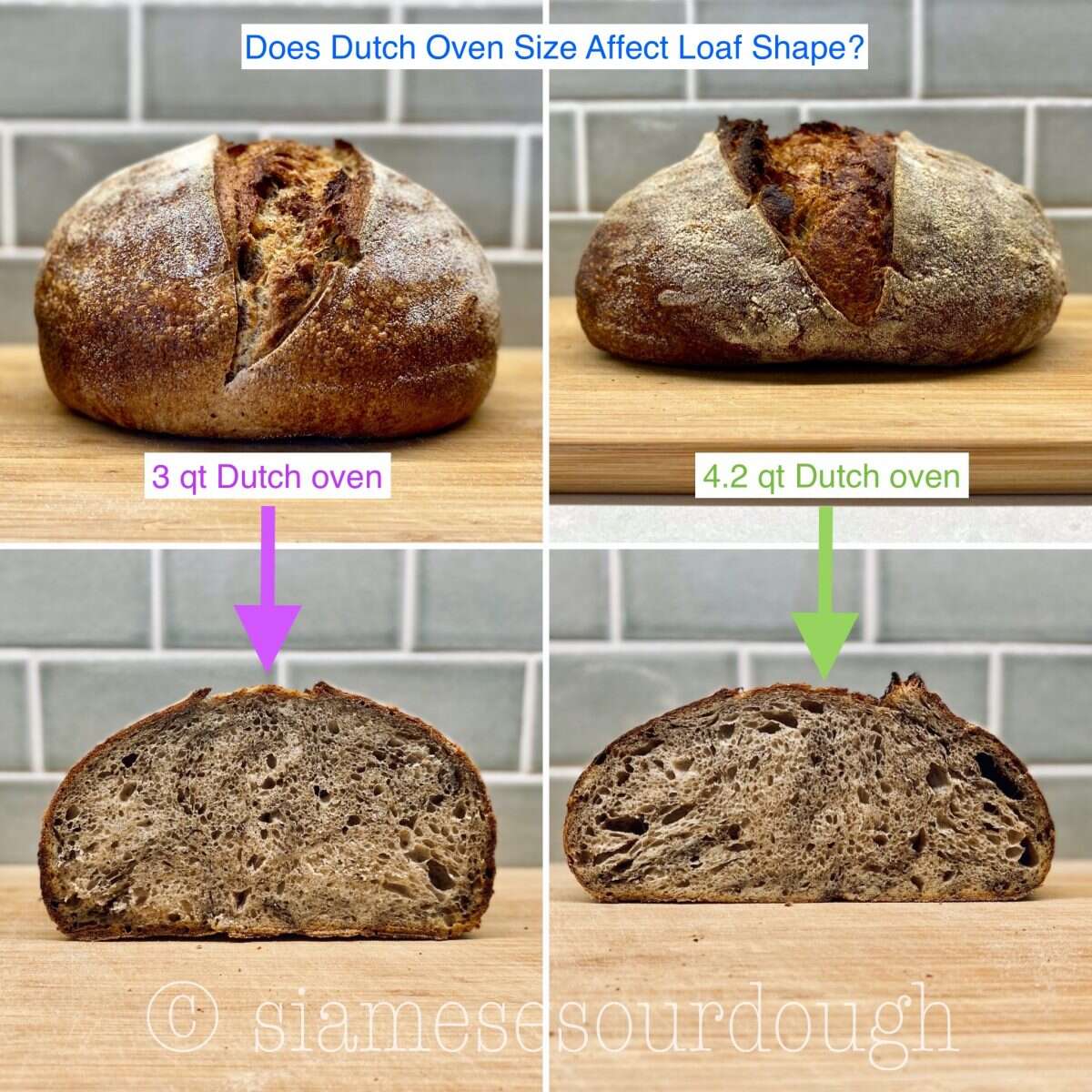
Credit: siamesesourdough.com
The Ideal Dutch Oven Size for Most Sourdough Loaves (Easy Answer)
Let me give you the short answer upfront:
⭐ The ideal size Dutch oven for most sourdough loaves is 5 to 5.5 quarts.
This is the gold standard for home bakers.
If you came here looking for a quick answer, that’s it.
But if you want to understand why—and make sure you’re not picking the wrong size for your style of baking—let’s break it down clearly and simply.
Why 5–5.5 Quarts Is the Sweet Spot
A 5-quart Dutch oven fits:
- A standard sourdough loaf
- 750g dough
- 800g dough
- 900g dough
- Up to about 1kg dough if shaped tight
It gives your dough enough room to spring upward—not outward—and still traps steam close around the loaf.
A 5.5-quart Dutch oven works almost exactly the same but offers just a touch more space without “losing” steam.
This is why many bakers (including me) choose a 5–5.5 quart size as the everyday bread baking Dutch oven.
Related keyword woven:
If you’re looking for the best Dutch oven for sourdough, it almost always lands in this size range.
Why a 4-Quart Dutch Oven Often Fails (My Story)
A 4 qt Dutch oven looks cute. It feels easy to lift. It feels like it “should” work.
And I wanted mine to work—until the day my dough rose up, pressed into the lid, and baked itself into the metal. When I lifted the lid, part of the top crust came right off with it.
It looked like my loaf left its hat behind.
So here’s the truth:
- A 4-quart Dutch oven is almost always too small.
- It limits your sourdough loft.
- It forces your loaf outward instead of upward.
- It kills your oven spring.
Save that 4 qt for stews.
Not sourdough.
Why 6–7 Quarts Might Be Too Big (Yes, Too Big Exists)
Baking sourdough in a 6 or 7 qt Dutch oven works—but only if:
- Your dough is 900g or bigger
- You bake large family loaves
- You want extra shaping space
- You don’t mind using more heat and time
The issue is steam retention.
A bigger pot means:
- more air space
- more steam loss
- weaker crust
I have a 7.25 qt Le Creuset, and although it’s beautiful (and weighs like a small meteor), I can tell you honestly:
My crust never comes out as blistered in that pot as it does in my 5.5 qt Lodge.
Small but not too small is the secret.
Understanding Dough Size and Why It Affects the Pot Size
Let’s talk dough weight because it changes everything.
Most home sourdough recipes produce 750g–900g dough.
You need room for:
- expansion
- lift
- sideways push
- and steam movement
Here’s a simple guide:
⭐ 750g dough → 5 qt perfect
⭐ 800–900g dough → 5–5.5 qt perfect
⭐ 1kg dough → 5.5–6 qt ideal
⭐ 1.2kg+ dough → 6–7 qt only if needed
And here’s the easy rule:
Your dough should never be closer than 1.5–2 inches from the lid.
The closer it gets, the flatter your loaf becomes.
Related keyword woven:
When you understand sourdough loaf size, picking the right Dutch oven size becomes simple.
Material Matters: Cast Iron vs Enameled Cast Iron vs Ceramic
If you search for the best Dutch oven for sourdough, you’ll see brands like:
- Lodge
- Le Creuset
- Staub
- Cuisinart
- Tramontina
Let me break down how each material impacts your bread.
Raw Cast Iron (Lodge, Smithey, Victoria)
Pros:
- Holds heat like a champ
- Creates strong steam
- Creates a thick, crunchy crust
- Affordable
Cons:
- Heavier
- Needs care
If you want the most “artisan bakery” results, a cast iron Dutch oven for bread is often the best choice.
Enameled Cast Iron (Le Creuset, Staub)
Pros:
- Easy to clean
- No seasoning
- Looks beautiful on the stove
Cons:
- Expensive
- Heavy
- Some enamel lids have lower heat safe limits
Staub has dark enamel inside—stains less, bakes better.
Le Creuset has light enamel—easier to see browning.
Both are excellent.
Ceramic or Clay Dutch Ovens
They work—but they:
- can crack under thermal shock
- heat unevenly
- do not last as long
- often have lower heat limits
I keep one, but I don’t use it for sourdough anymore.
Credit: thefeatherednester.com
Diameter vs Depth: The Real Secret Most Guides Ignore
This is something most people never mention.
You need:
⭐ 8–9 inches of interior width.
Dough needs sideways expansion, not just upward lift.
Too narrow = mushroom loaf.
Too wide = flat loaf.
Depth is less important.
Width is everything.
This is why the Dutch oven size guide always leans toward medium-size pots.
Why Steam Retention Is What Actually Makes Your Bread Shine
When I first started baking sourdough, I couldn’t understand why my crust stayed pale.
Then I learned something simple:
Steam keeps your crust soft longer.
Soft crust = more rise.
More rise = open crumb + shiny crust.
A tight lid traps steam right at the surface of your loaf.
This is where 5–5.5 qt shines again.
Brands like Lodge, Staub, and Le Creuset create lids that seal heat and steam better, which is why they dominate as the best Dutch oven for sourdough.
And yes—I tested all three.
Choosing the Right Dutch Oven for Your Oven (Yes, Your Oven Size Matters)
Before you buy anything, check:
- your oven width
- how your rack sits
- your door clearance
Some Dutch ovens—especially 7 qt and up—are huge.
One time, I bought a 7 qt pot that couldn’t sit straight in my oven.
It fit only at an angle, and my loaf baked unevenly because of it.
So check this first:
Will the pot sit centered in the oven with room for heat to move around it?
This alone can change your crust.
Should You Preheat Your Dutch Oven? (Short Answer: Usually Yes)
Most bakers preheat their Dutch oven at 450–500°F for:
- huge oven spring
- crisp crust
- better lift
But brand guidelines matter.
Lodge raw cast iron:
High heat safe. Preheat freely.
Le Creuset:
Lid knob safe to 480°F.
Staub:
Knob safe over 500°F, enamel safe, but warm gradually.
If you use enamel, warm it gently.
Steam plus enamel plus shock = cracks.