Changing a belt on a Riccar vacuum cleaner usually takes about 15 to 30 minutes. In most U.S. Riccar upright models, the job involves removing the nozzle cover, taking out the brush roll, fitting the correct belt around the motor shaft and brush roll, and putting the cover back in place.
The exact steps vary by model. Riccar sells several upright lines, including Supralite, R10, R20, R25, and Tandem Air models. Before you begin, check the model number on your vacuum and use the matching Riccar owner’s manual or replacement-belt listing.
A worn belt can make the brush roll stop turning, cause a burning-rubber smell, or leave the vacuum running with poor cleaning results. This guide explains how to replace the belt safely and how to tell when the belt is not the real problem.

Before You Start
Gather the correct belt, a Phillips screwdriver, a flat work surface, and a clean cloth. A flashlight can also help you spot hair, thread, or debris around the brush roll.
Identify your Riccar model
Look for the model number on one of these areas:
- The back or bottom of the vacuum
- A label near the power cord
- The dust bag compartment
- The handle or nozzle housing
- The original owner’s manual
Do not assume that all Riccar belts are interchangeable. Belts may look similar but differ in length, width, material, or fit. A belt that is too loose may slip. One that is too tight may strain the motor or brush-roll bearings.
Use the model number to confirm the correct belt through:
- The Riccar owner’s manual
- Riccar’s official parts or support pages
- An authorized Riccar dealer
- The belt package, if it lists compatible models
Check whether the belt needs replacement
A belt may need changing if:
- The brush roll does not spin
- The brush roll spins slowly or stops under light pressure
- The vacuum makes a squealing sound
- You smell hot rubber after a short use
- The belt looks stretched, cracked, shiny, frayed, or broken
- The vacuum picks up less dirt from carpet
- The brush-roll indicator, if fitted, shows a fault
A broken belt is not the only possible cause. Hair wrapped around the brush roll, a jammed bearing, a blocked nozzle, or a faulty belt-control switch can cause similar symptoms.
Safety steps
Follow these safety rules before opening the vacuum:
- Turn the vacuum off.
- Unplug it from the wall outlet.
- Let the motor cool if you noticed heat or a burning smell.
- Keep fingers away from the belt path while the vacuum is connected to power.
- Do not test the vacuum with the cover removed unless the manual specifically allows it.
- Keep screws and small parts away from children and pets.
Unplugging the vacuum is not optional. The brush roll can start without warning on models with automatic brush-roll controls.
Most belt changes need no electrical work. If you see damaged wires, melted plastic, smoke, or signs of motor damage, stop and arrange service.

How to Change a Belt on a Riccar Vacuum Cleaner
The general method below applies to many Riccar upright vacuums. Your model may use different screws, a different belt cover, or a separate brush-roll release system. If a part does not move with normal hand pressure, stop and check the model manual rather than forcing it.
1. Prepare the vacuum
Place the unplugged vacuum on a table or floor with the underside of the nozzle facing up. If the handle folds, place it in the position that gives you clear access to the bottom plate.
Remove the dust bag or empty the dirt container if it could fall out while you work. Keep the cord away from the work area.
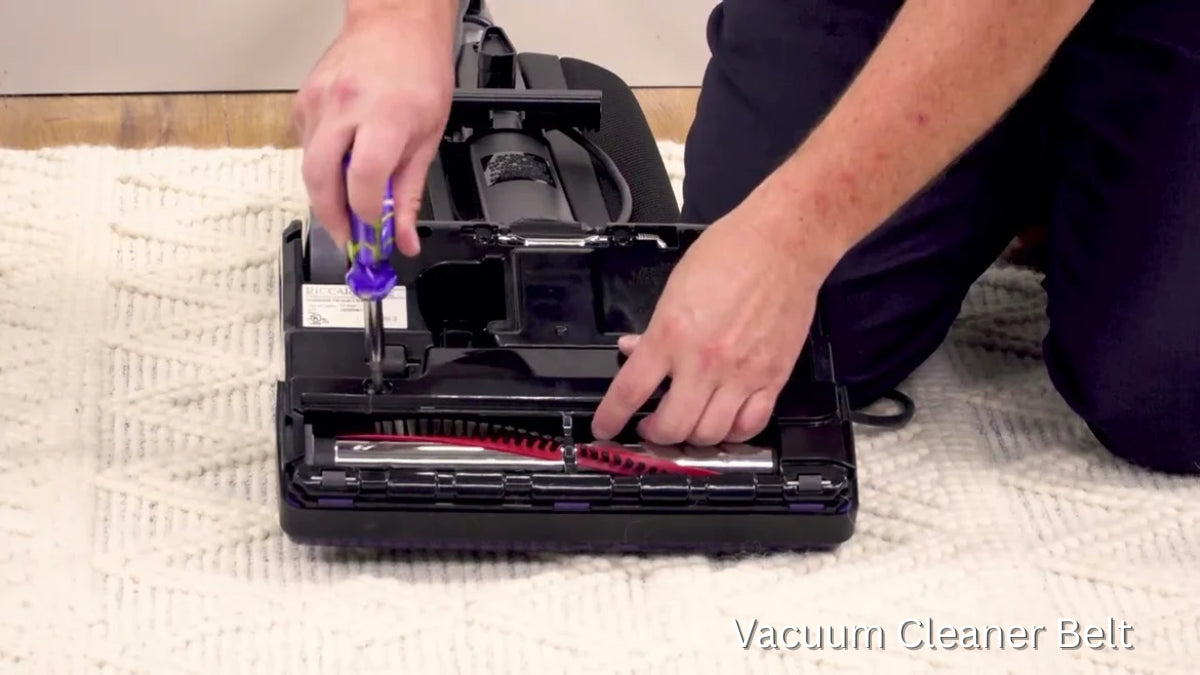
2. Remove the nozzle cover or bottom plate
Find the screws that hold the belt cover or bottom plate in place. On many models, these screws are on the underside of the cleaning head.
Remove the screws and place them in a small container. Lift the cover carefully. Some covers have tabs, guides, or a headlight wire nearby, so do not pull hard.
If the cover does not lift:
- Check for a hidden screw.
- Look for a latch or release tab.
- Confirm that you are removing the correct plate.
- Check the model-specific manual.
A plastic cover can crack if you twist it with a screwdriver.
3. Inspect the brush roll and old belt
Before removing anything, look at the belt path. Note how the old belt sits around the motor shaft and brush roll. A quick photo can help you remember the route.
Cut a broken belt with scissors or pull it off the shaft. If the belt is still tight, rotate the brush roll by hand while easing the belt off. Keep your fingers clear of sharp edges and packed debris.
Inspect the brush roll for:
- Hair wrapped around the end caps
- Thread or carpet fiber
- Cracks
- Missing bristles
- Bent ends
- Stiff or noisy bearings
Remove wrapped hair and thread before installing the new belt. Debris can make a new belt fail quickly.
4. Fit the new belt around the motor shaft
Place the new belt around the motor shaft or belt pulley. The motor shaft is usually the smaller metal shaft near one side of the nozzle.
Then fit the belt around the correct section of the brush roll. The belt must sit in the brush roll’s belt channel or pulley area. It should not rest on the bristle strip unless the Riccar design specifically uses that arrangement.
Make sure the belt is not twisted. A twisted belt may rub against the housing and wear unevenly.
5. Reinstall the brush roll
Put the brush roll back into the nozzle. The end caps or mounting tabs must sit fully in their slots.
If the brush roll uses different end shapes, match each end to the correct side. Do not force the roll into place. A brush roll that is not seated correctly can bind when the vacuum runs.
Once installed, rotate the brush roll by hand several times. The new belt should stretch and move the brush roll. Some resistance is normal because the belt is under tension.
6. Replace the cover
Reinstall the nozzle cover or bottom plate. Align the tabs first, then replace the screws.
Tighten the screws until they are secure. Do not overtighten them, especially in plastic. Overtightening can strip the screw holes or warp the cover.
Check that:
- The cover sits flush
- No part of the belt is trapped under the cover
- The brush roll turns by hand
- The nozzle has no loose screws or gaps
7. Test the vacuum
Place the vacuum upright and reconnect the power. Turn it on for a few seconds.
Listen for:
- A steady motor sound
- A brush roll that turns smoothly
- No squealing
- No scraping
- No burning-rubber odor
Turn the vacuum off and unplug it again if you hear grinding, see smoke, or smell strong hot rubber. A new belt can produce a mild rubber smell for a short time, but a strong or worsening odor is not normal.

How to Tell Whether the New Belt Is Installed Correctly
The new belt is installed correctly when the brush roll turns with the motor, the cover sits flat, and the vacuum runs without unusual noise or heat.
With the vacuum unplugged, turn the brush roll by hand. It should move with noticeable belt resistance but should not feel locked. The belt should remain in its groove and should not climb the side of the pulley.
During the first test:
- Run the vacuum for several seconds.
- Watch or listen for normal brush-roll operation.
- Turn it off.
- Unplug it.
- Check for belt movement, rubbing, or heat near the nozzle.
Do not hold the vacuum in one place on carpet during the first test. A stationary powered brush roll can heat the carpet and belt.
Correct and incorrect belt conditions
| Condition | What it usually means | Action |
|---|---|---|
| Brush roll turns smoothly | Belt is likely routed correctly | Use the vacuum normally |
| Brush roll does not turn | Belt is broken, misrouted, loose, or the brush roll is jammed | Unplug and inspect |
| Loud squeal | Belt may be too tight, misaligned, or rubbing | Recheck belt path |
| Burning-rubber smell | Belt may be slipping or the brush roll may be blocked | Stop and inspect |
| Brush roll turns by hand but not when powered | Belt may not be gripping the motor shaft, or the motor control has a fault | Check routing, then seek service |
| Cover will not sit flat | Belt, brush roll, or internal part is out of position | Remove the cover and realign parts |
A belt that repeatedly breaks is usually a symptom of another problem. Replacing it again without checking the brush roll, bearings, nozzle, and motor pulley may waste time and parts.

What to Do if the Riccar Vacuum Still Does Not Work
If the vacuum still has no brush-roll action after the belt change, check the problem in a safe order. Begin with simple mechanical causes before assuming the motor has failed.
The brush roll does not spin
Unplug the vacuum and check whether the brush roll turns by hand.
- If it is difficult to turn, remove hair and debris.
- If it feels rough or makes noise, the brush-roll bearing may be worn.
- If it turns freely but the belt slips, check the belt size and routing.
- If the belt is intact but the motor shaft does not turn, service may be needed.
Some Riccar models include a brush-roll switch or automatic shutoff. Confirm that the switch is in the correct position and that the nozzle is fully engaged, if your model uses that feature.
The vacuum makes a loud squeal
A squeal may come from:
- A belt that is incorrectly routed
- A belt that does not match the model
- A brush roll that is blocked
- A worn brush-roll bearing
- A damaged motor pulley
Switch the vacuum off and unplug it. Do not spray oil or lubricant on the belt. Oil can damage the belt and attract dust.
The vacuum smells hot after the belt change
Stop using the vacuum if the smell is strong, the belt smokes, or the nozzle becomes very hot.
A brief mild rubber smell may occur with some new belts. A strong smell usually points to slipping, friction, a jammed brush roll, or an incorrect belt. Inspect the belt for shiny spots, melted edges, or black residue.
The new belt breaks quickly
A new belt that breaks soon after installation may indicate:
- The wrong replacement belt
- A brush roll packed with hair
- A seized bearing
- A sharp edge inside the nozzle
- A damaged motor pulley
- A cover that presses against the belt
- A brush roll that is not seated correctly
Do not keep replacing belts until the cause is found. Repeated belt failure can damage other parts of the vacuum.
The vacuum has weak suction after the repair
A belt change does not fix every cleaning problem. Check the bag or dirt container, filters, hose, intake path, and nozzle for blockages.
If the brush roll turns but the vacuum still cleans poorly, the issue may be airflow rather than the belt. Follow the maintenance instructions for your exact Riccar model.

When to Use a Riccar Repair Service
Use a qualified vacuum repair shop or Riccar service provider when the belt change does not solve the problem or when the vacuum shows electrical damage.
Arrange service if:
- The power cord is damaged
- The vacuum sparks or emits smoke
- The motor makes grinding or burning noises
- The brush-roll motor does not run
- The nozzle housing is cracked
- A screw mount has broken
- The belt keeps failing
- You cannot identify the correct belt
- The vacuum is still under warranty
Do not open the motor housing unless the service instructions for your model allow it. Internal electrical parts can hold hazards even after the vacuum is unplugged.
A repair professional can test the motor, brush-roll assembly, belt-control circuit, wiring, and bearings. That may cost less than repeatedly buying belts or replacing a damaged nozzle.
How Often Should You Replace a Riccar Vacuum Belt?
Replace a Riccar belt when it is worn, stretched, cracked, or broken rather than following one universal calendar interval. The correct service interval depends on the vacuum model, floor type, use, and maintenance.
Homes with pets, long hair, thick carpet, or frequent daily cleaning may place more load on the brush roll. Regularly remove hair and thread from the brush roll. This reduces drag and helps protect the belt.
During routine care:
- Inspect the belt when cleaning the brush roll.
- Check the brush roll for wrapped fibers.
- Replace a belt that looks shiny or stretched.
- Use only the belt specified for the model.
- Keep filters and air paths clean.
- Stop using the vacuum if the belt slips or smells hot.
Do not stretch an old belt to judge its condition. A belt may look intact but still slip because it has lost tension.

Common Mistakes to Avoid
The most common belt-replacement mistakes are using the wrong belt, skipping brush-roll cleaning, and testing the vacuum before the cover is secure.
Avoid these errors:
- Buying a belt based only on the vacuum’s brand
- Forgetting to unplug the vacuum
- Routing the belt around the wrong part of the brush roll
- Leaving the belt twisted
- Trapping the belt under the nozzle cover
- Reusing a belt that is cracked or stretched
- Forcing the brush roll into its slots
- Overtightening plastic screws
- Ignoring a grinding brush-roll bearing
- Running the vacuum with a damaged cover
- Applying lubricant to the belt
- Replacing belts repeatedly without finding the cause
The belt should drive the brush roll, not compensate for a jammed or damaged brush-roll assembly.

Frequently Asked Questions
Can I change a Riccar vacuum belt myself?
Yes, many Riccar upright belts are replaceable by the owner with basic tools. The job is usually mechanical, but the exact access method differs by model. Check the model-specific manual before removing the nozzle cover.
What belt does my Riccar vacuum need?
The correct belt depends on the exact Riccar model and sometimes the nozzle or brush-roll design. Find the model number on the vacuum, then match it to the belt listed in the official manual or Riccar parts information. Do not rely on appearance alone.
Why does my Riccar vacuum smell like burning rubber after a belt change?
The belt may be slipping, misrouted, too tight, or rubbing against the cover. A blocked brush roll can create the same smell. Turn the vacuum off, unplug it, and inspect the belt and brush roll before using it again.
Should the Riccar brush roll spin when the vacuum is off?
You should be able to turn the brush roll by hand when the vacuum is unplugged, although the belt will create some resistance. Never place your fingers near the brush roll while the vacuum is connected to power.
Why does the new belt keep coming off?
The belt may be the wrong size, twisted, installed in the wrong groove, or affected by a loose brush-roll end cap. A worn motor pulley or brush-roll bearing can also throw the belt off. Inspect the full belt path instead of installing another belt immediately.
Where can I find Riccar repair instructions?
Start with the owner’s manual for the exact model. Riccar’s official support resources and authorized dealers may provide manuals, parts information, or service options. If the manual does not cover belt replacement, contact an authorized service provider.
Final Takeaway
To change a belt on a Riccar vacuum cleaner, unplug the vacuum, remove the nozzle cover, take out the brush roll, install the model-correct belt around the motor shaft and brush roll, then reinstall the parts and test the machine.
The key check is not simply whether the new belt fits. The brush roll must turn freely, the belt must sit in the correct groove, and the vacuum must run without squealing, scraping, or a strong hot-rubber smell. If the belt fails again, inspect the brush roll and bearings or have the vacuum serviced instead of replacing belts repeatedly.

Liora Pennings is a seasoned chef and kitchen enthusiast with a passion for turning everyday cooking into an effortless experience. With years of hands-on culinary expertise, she specializes in practical techniques, ingredient know-how, and smart kitchen solutions that help home cooks elevate their meals. At KitchFlair.com, Liora shares her best tips, time-saving tricks, and honest product reviews to guide readers toward a more efficient, enjoyable, and inspired cooking routine. Whether you’re a beginner or a seasoned home chef, Liora’s friendly, knowledge-packed insights make every visit to the kitchen a little easier—and a lot more delicious.