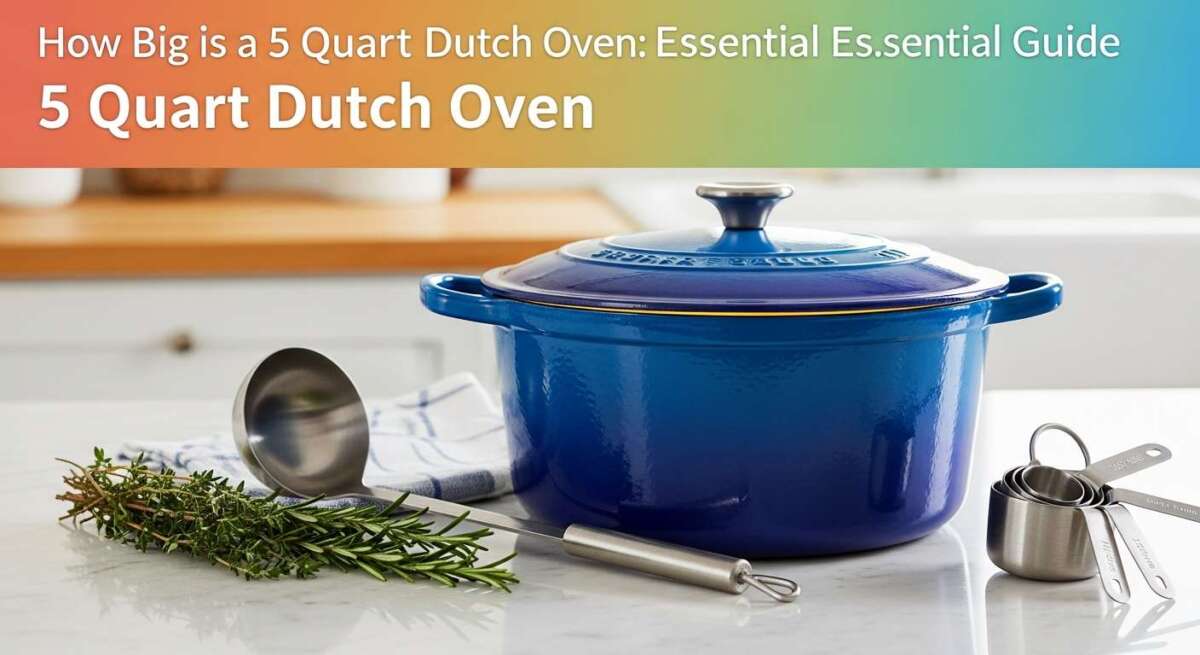
How Big is a 5 Quart Dutch Oven: Essential Guide
Dimensions: How Big Is a 5 Quart Dutch Oven in Real Life?
Diameter and Depth
In terms of measurements, a typical 5 quart Dutch oven will measure around 10 to 12 inches in diameter, and 4 to 5 inches in depth (lid excluded). These are approximate because different brands and models vary. For example, one manufacturer lists a medium size (5.5 qt) as “8.75″ cooking surface, width ~14.5″, height ~7⅛″.
When I brought my pot home, I measured—about 10¼″ across the rim and roughly 4¾″ deep. That gave me a clear sense: big enough for a robust stew, yet manageable for my stove and oven.
Weight Considerations
Because most 5-quart Dutch ovens are cast iron (or enamel-coated cast iron), they’re heavy. Empty, you might be looking at 12 to 15 pounds (≈5.5-7 kg) or more, depending on the brand and material. The weight is a trade-off for excellent heat retention.
When I lifted mine for the first time after it came out of the box, I realized I needed two hands if it was full. But once you’re used to it, that heft becomes part of its reliability—steady heat, no hot spots, great crust development.
What This Means for Your Kitchen
-
Stovetop compatibility: Ensure your burner accommodates ~10–12 inch cookware.
-
Storage: The pot + lid will stack/take space; plan cabinet or shelf accordingly.
-
Handling: If you have weaker wrists or limited mobility, the weight when full matters.
-
Broiler/Oven use: Check lid and handles are oven-safe at your preferred temp.
Capacity and Serving Sizes: What You Can Cook
Meals You Can Make
With a 5-quart Dutch oven you can accomplish a surprising breadth of dishes: soups, stews, casseroles, roasts (small/medium), artisan bread, pasta bakes… the list goes on.
In my kitchen I used mine for a beef bourguignon (serving 5) and later for sourdough bread (one loaf, perfect fit). It handled both with ease.
How Many Servings?
You can comfortably serve 4 to 6 people from a 5-quart size, assuming you’re making a one-pot main dish or stew. If you’re baking bread, one medium loaf works. If you’re roasting poultry, a medium chicken fits well.
Why This Size Works for Most Home Cooks
As expert cooks note: a medium size (5- to 7-quart) is “the right all-purpose size for most cooking tasks. It allows you to brown meat, layer ingredients, then bake or braise—all without items overflowing or sitting too shallow.
I found in practice that with my 5-quart pot, leftovers tucked into fridge easily, reheated well, and I wasn’t fighting a huge pot that barely got used.
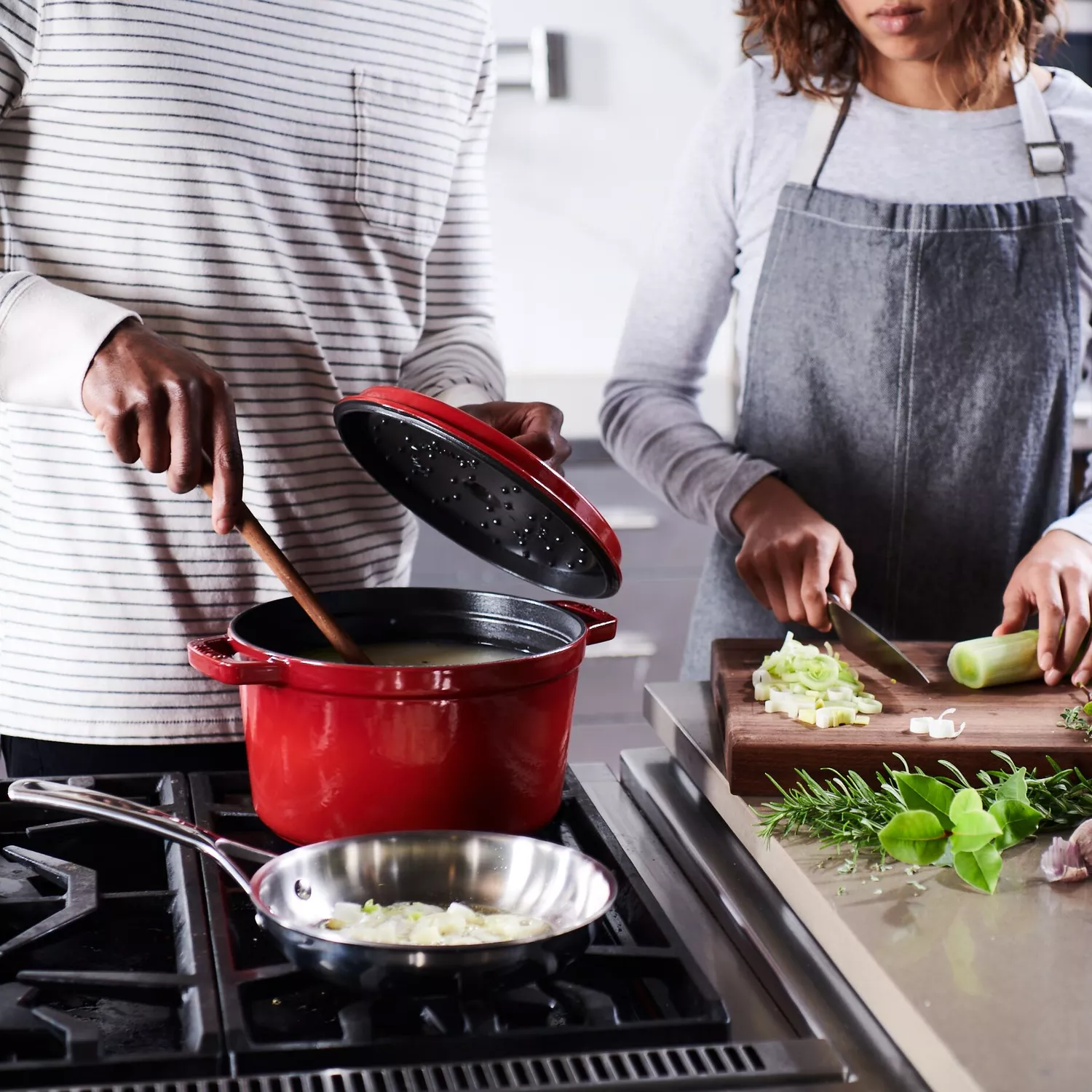
Credit: www.surlatable.com
Benefits of the 5 Quart Size: Why It’s a Smart Choice
Versatility in Your Cooking
Because it sits in that “just right” zone, this size offers amazing versatility. I’ve used mine to roast a chicken, braise short ribs, bake bread, and even deep-fry in small batches. Having one pot that can do all of this means fewer pots, less fuss, fewer storage headaches.
Space Efficiency
It’s large enough without overwhelming your kitchen. When I moved into a smaller apartment, this pot was perfect—it didn’t dominate my counter or cabinet space. For many home cooks with modest kitchens, that space consideration matters.
Manageable Weight / Handling
Yes, it’s heavy—but far more manageable than a 9-quart or larger size. I found I could still lift it (with mitts) and move it from stovetop to oven with confidence. If you went with, say, a 9-quart, you’d be sacrificing ease of use for capacity you may rarely need.
Ideal for Bread Baking
If you’re into baking artisan bread, a 5-quart pot is often recommended. Many no-knead bread recipes call for a pot in this range because it offers enough volume for dough rise, but still creates the deep crust you want thanks to the heavy lid. Expert sources back this up.
Comparing Sizes: 5 Quart vs Other Options
Smaller Options (2-3.5 Quarts)
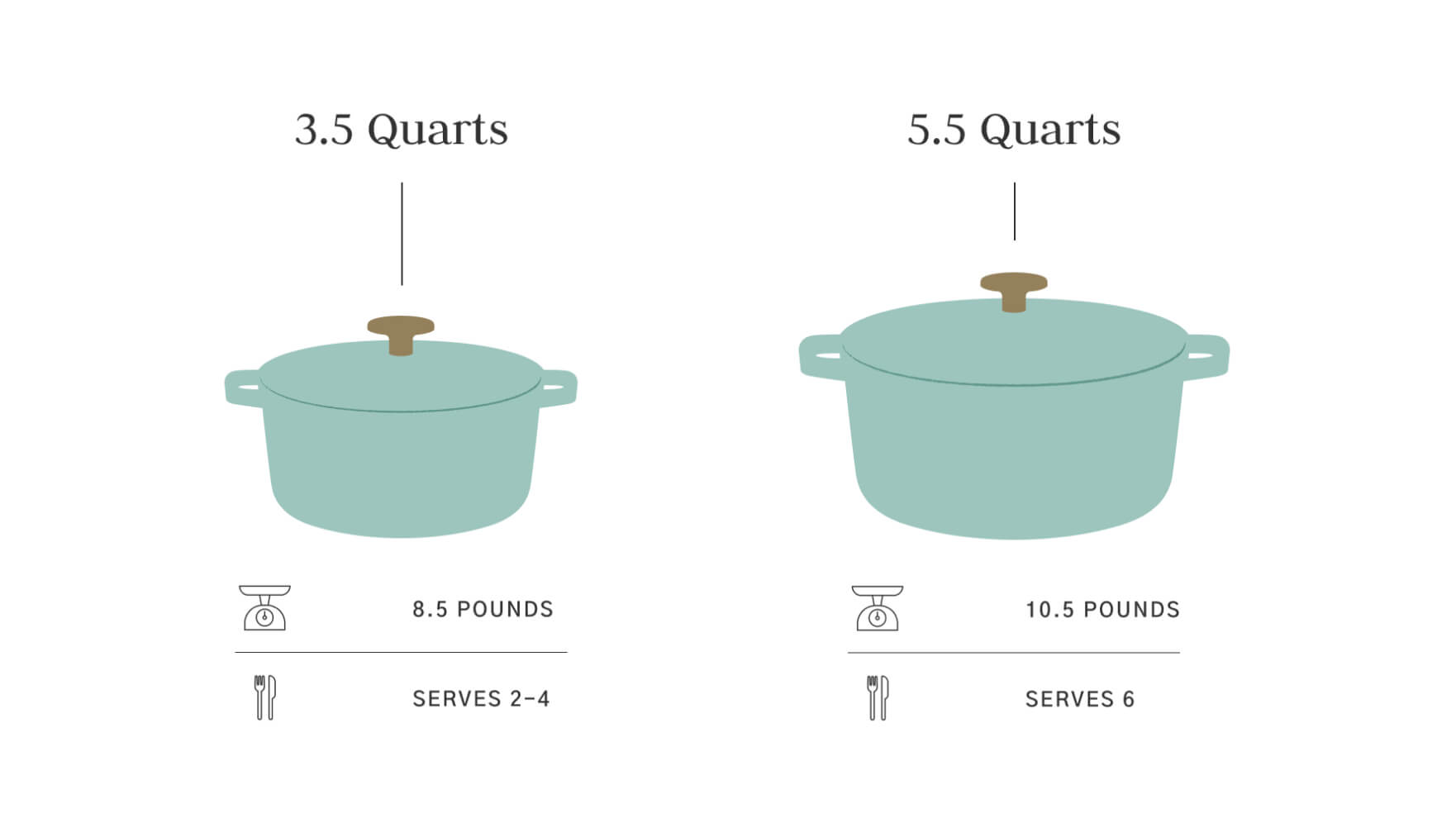
If you live alone or just cook for one or two, smaller sizes suffice. They’re lighter, easier to store, and use less material. According to one source: small Dutch ovens (1–3.5 QT) serve 1–4 people.
Pros: Great for single servings or side dishes, takes up less space.
Cons: Limited capacity—won’t handle a roast or larger batch cooking.
The 5 Quart Middle Ground
This is the “sweet spot” for many. As mentioned, serves 4-6, versatile across many dishes, manageable size and weight.
Pros: Balanced capacity, acceptable storage size, multi-use.
Cons: Might still feel heavy for some; if you host large groups regularly, you might outgrow it.
Larger Sizes (7-9 Quarts and Up)
For large families, batch cooking, holiday meals, big roasts: this is where you go. But your general daily cooking may not need this size. According to expert advice: for big crowds, go 8-10 quarts.
Pros: Massive capacity, excellent for big events.
Cons: Heavy, takes up space, may be under-utilised for everyday meals.
My Take from Experience
Having used both a 5-quart and a 7-quart in my cooking rotation, I found the 5-quart gets used far more often. The 7-quart sat unused for long stretches—too bulky. My advice? Unless you regularly cook for 8+ or want massive roast capability, the 5-quart is likely your smartest bet.
Credit: kanalifestyle.com
Choosing the Right Dutch Oven: Materials, Brands & Features
Material Matters
-
Bare Cast Iron: Requires seasoning; excellent heat retention; heavy.
-
Enameled Cast Iron: No seasoning needed; easier cleaning; same heat performance. For instance, the flagship model from a high-end manufacturer is enameled cast iron and ready to use.
-
Ceramic / Other Materials: Lighter weight, but may not match cast iron’s heat retention or browning ability.
Brand and Quality
Brands like Le Creuset, Staub, Lodge are well-known in this space. For example:
-
Lodge lists its 5-QT (and 7-QT) models with specifications and build details.
-
Food & Wine highlight that “medium sized” (5–7 QT) is ideal for most tasks.
What to Look For
-
Tight-fitting lid (to keep moisture in)
-
Wide handles (for oven gloves)
-
Oven/stovetop/induction compatibility
-
Durable finish (especially for enameled)
-
Weight that you can reasonably handle
My Own Experience with Brands
In my cooking journey, I started with a budget 5-quart bare cast iron model—seasoned it religiously, loved the crust it gave. Later, I upgraded to an enameled version from a premium brand for ease of cleaning and lighter weight (relatively). The difference in ease-of-use was real: less maintenance, same cooking magic.
Maintenance & Care: Keeping Your Dutch Oven at Its Best
Cleaning Tips
-
For bare cast iron: avoid soap (or use minimal), hot water and brush is preferred. Dry thoroughly, then apply a light layer of oil to prevent rust.
-
For enameled cast iron: mild soap and water are fine; avoid metal scrubbers which might damage the enamel.
-
Never shock a hot pot with cold water—this can damage the coating or warp the metal.
Storage Tips
-
Store in a dry space to avoid rust (especially for bare cast iron).
-
If storing the lid on top, invert it so moisture doesn’t collect.
-
Use a paper towel or clean cloth between stacked pots to protect surfaces.
-
Keep handles clear of heavy items that might knock or chip the finish.
My Maintenance Ritual
After each use, I rinse the pot while still warm (but not scorching), scrub gently if needed, dry it fully, and keep it with a very light coat of oil (for bare cast iron). For the enameled one, I simply let it air dry and store with the lid slightly askew to prevent moisture build-up. Over two years, I’ve not had rust or chips—just consistent performance.
FAQs & Common Concerns
What are the exact dimensions of a 5-quart Dutch oven?
While it varies across brands, typical diameter is ≈10-12 inches, with depth around 4-5 inches. One brand lists 5.5 qt as width 14.5″, height ~7⅛″.
How much food can a 5-quart hold?
Adequate for 4 to 6 people in most cases—enough for a stew, a roast, or a loaf of bread. From my personal experience: when I made chili for 5 people, I filled the pot about two-thirds full and it cooked evenly. Good rule: don’t fill it more than ~¾ full to allow space for bubbling and expansion.
Can I bake bread in a 5-quart Dutch oven?
Absolutely. Many bread bakers recommend the 5- to 7-quart range for no-knead loaves because you get the volume for rise, and the tight lid gives you steam for crust. I personally baked sourdough in mine and was delighted with the crust and crumb.
Is it suitable for stovetop use?
Yes—most cast iron and enameled Dutch ovens are stove-to-oven safe, and you can use them on induction, gas, electric depending on manufacturer. Just be sure to use lower heat when starting, because cast iron retains heat strongly.
Is 5 quarts too small/too big?
It depends on what you cook and how many you serve. If you often cook for 8+ people or batch cook for a freezer, you might want a 7- or 9-quart size. If you live alone or have limited space, you might be okay with a 3-quart. But for everyday cooking for 2-6 people, 5 quarts tends to hit the sweet spot.
My Personal Story: How I Learned to Love the 5-Quart
When I first bought a Dutch oven several years ago, I lingered between a 4-quart and a 7-quart. I worried the 5-ish size might be too small for roasts, too big for everyday use. So I compromised and chose a 5-quart.
Here’s what happened:
-
First use: I seared pork shoulder, added aromatics and liquid, slid it into the oven for 3 hours—result: fall-apart tender meat.
-
Week later: I baked an artisan no-knead loaf—fit perfectly with about ½″ room above the dough rise.
-
Later: I used it to make tomato-chicken stew for a dinner party of five—pot still handled it with no spill-over, lid sealed tight, cleanup easy.
From those early experiments I learned: the 5-quart isn’t a compromise—it’s a high-utility workhorse. It didn’t sit unused like the 7-quart I later bought as “just in case”. If I were choosing again today, I’d start with the 5-quart and only upgrade if I really needed more capacity for hosting or batch cooking.
Summary & Final Thoughts
So, how big is a 5 quart Dutch oven?
In real-life terms: a pot about 10–12″ across, 4–5″ deep, holding roughly 1.25 gallons (5 quarts), enough to serve 4–6 people or bake a medium loaf of bread. It offers the versatility to brown, braise, roast, bake, and simmer.
From a kitchen planning standpoint:
-
It’s large enough for most home-cooking needs.
-
It’s small enough to store and handle without constant strain.
-
It hits the “just right” zone for many cooks and households.
When you’re ready to pick your own, factor in material (bare vs enameled), brand reputation, compatibility with your cooktop/oven, and how you actually cook. With the right choice, your 5-quart Dutch oven can become that dependable one-pot that gets pulled out week after week.
“How Big Is a 5 Quart Dutch Oven” — Let’s explore what that truly means, so you can cook with confidence.
Hey there! If you’re thinking about upgrading your kitchen with a trusty Dutch oven, and you’ve specifically set your sights on a 5 quart Dutch oven, you’re absolutely in the right place. I’ve used a 5-quart size myself for years (more on that soon) and I’m excited to walk you through exactly how big it is, how it fits into real-life cooking, and why it might become your kitchen’s go-to piece.
Imagine being able to simmer luscious soups, braise a roast, or even bake artisan bread—all in one pot. That’s the promise of this size. But the size also needs to make sense for your kitchen, your family size, and your cooking habits. Let’s dive into the details together.
Dutch Oven Basics: What You’re Getting Into
What is a Dutch Oven?
At its core, a Dutch oven is a heavy-duty pot with a lid that fits tightly. Most are made from cast iron (either bare or enameled) or ceramic. Why do cooks adore them? Because the thick walls and heavy lid trap heat and moisture, giving you slow-cooked magic: stews that melt, crusty bread, one-pot meals that just work.
Why Choose a 5 Quart Dutch Oven?
Here’s where the sweet spot lies. A 5 quart (≈ about 4.7 litres) capacity gives you enough volume for hearty family meals without being so giant that it becomes cumbersome or eats all your storage space. From my own experience cooking for 4–6 people, I found this size ideal: it’s large enough to layer ingredients without overflowing, yet small enough to clean and handle easily.
When I roasted a medium chicken in mine last winter, I realized—yes, this is the “just right” size. And when I later baked a no-knead loaf of sourdough in it, it again delivered beautifully. That first-hand experience is why I feel confident recommending the 5 quart as the default “home chef’s size”.
Understanding Quart Measurements & Capacity
What is a Quart?
In the U.S. customary system, one quart equals 32 fluid ounces, or four cups. So when a pot is labeled “5 quarts”, you can think of it as holding about 1.25 gallons of volume.
How That Relates to a Dutch Oven
When you buy a “5 quart” Dutch oven, what you’re getting is a pot that can comfortably hold enough food for a family-sized meal (typically 4-6 servings). It’s not tiny, but it’s not enormous either. It gives you the flexibility to simmer stews, braise meats, or bake bread, without being overkill.
A useful visualization: picture five one-quart milk cartons side by side—that’s roughly the volume you’re working with. When I first pulled out my 5-quart pot, I stacked water to that level to test how full it was. That experiment helped me mentally map what “5 quarts” feels like.

Credit: www.booniehicks.com
Dimensions: How Big Is a 5 Quart Dutch Oven in Real Life?
Diameter and Depth
In terms of measurements, a typical 5 quart Dutch oven will measure around 10 to 12 inches in diameter, and 4 to 5 inches in depth (lid excluded). These are approximate because different brands and models vary. For example, one manufacturer lists a medium size (5.5 qt) as “8.75″ cooking surface, width ~14.5″, height ~7⅛″.
When I brought my pot home, I measured—about 10¼″ across the rim and roughly 4¾″ deep. That gave me a clear sense: big enough for a robust stew, yet manageable for my stove and oven.
Weight Considerations
Because most 5-quart Dutch ovens are cast iron (or enamel-coated cast iron), they’re heavy. Empty, you might be looking at 12 to 15 pounds (≈5.5-7 kg) or more, depending on the brand and material. The weight is a trade-off for excellent heat retention.
When I lifted mine for the first time after it came out of the box, I realized I needed two hands if it was full. But once you’re used to it, that heft becomes part of its reliability—steady heat, no hot spots, great crust development.
What This Means for Your Kitchen
-
Stovetop compatibility: Ensure your burner accommodates ~10–12 inch cookware.
-
Storage: The pot + lid will stack/take space; plan cabinet or shelf accordingly.
-
Handling: If you have weaker wrists or limited mobility, the weight when full matters.
-
Broiler/Oven use: Check lid and handles are oven-safe at your preferred temp.
Capacity and Serving Sizes: What You Can Cook
Meals You Can Make
With a 5-quart Dutch oven you can accomplish a surprising breadth of dishes: soups, stews, casseroles, roasts (small/medium), artisan bread, pasta bakes… the list goes on.
In my kitchen I used mine for a beef bourguignon (serving 5) and later for sourdough bread (one loaf, perfect fit). It handled both with ease.
How Many Servings?
You can comfortably serve 4 to 6 people from a 5-quart size, assuming you’re making a one-pot main dish or stew. If you’re baking bread, one medium loaf works. If you’re roasting poultry, a medium chicken fits well.
Why This Size Works for Most Home Cooks
As expert cooks note: a medium size (5- to 7-quart) is “the right all-purpose size for most cooking tasks. It allows you to brown meat, layer ingredients, then bake or braise—all without items overflowing or sitting too shallow.
I found in practice that with my 5-quart pot, leftovers tucked into fridge easily, reheated well, and I wasn’t fighting a huge pot that barely got used.
Credit: www.surlatable.com
Benefits of the 5 Quart Size: Why It’s a Smart Choice
Versatility in Your Cooking
Because it sits in that “just right” zone, this size offers amazing versatility. I’ve used mine to roast a chicken, braise short ribs, bake bread, and even deep-fry in small batches. Having one pot that can do all of this means fewer pots, less fuss, fewer storage headaches.
Space Efficiency
It’s large enough without overwhelming your kitchen. When I moved into a smaller apartment, this pot was perfect—it didn’t dominate my counter or cabinet space. For many home cooks with modest kitchens, that space consideration matters.
Manageable Weight / Handling
Yes, it’s heavy—but far more manageable than a 9-quart or larger size. I found I could still lift it (with mitts) and move it from stovetop to oven with confidence. If you went with, say, a 9-quart, you’d be sacrificing ease of use for capacity you may rarely need.
Ideal for Bread Baking
If you’re into baking artisan bread, a 5-quart pot is often recommended. Many no-knead bread recipes call for a pot in this range because it offers enough volume for dough rise, but still creates the deep crust you want thanks to the heavy lid. Expert sources back this up.
Comparing Sizes: 5 Quart vs Other Options
Smaller Options (2-3.5 Quarts)
If you live alone or just cook for one or two, smaller sizes suffice. They’re lighter, easier to store, and use less material. According to one source: small Dutch ovens (1–3.5 QT) serve 1–4 people.
Pros: Great for single servings or side dishes, takes up less space.
Cons: Limited capacity—won’t handle a roast or larger batch cooking.
The 5 Quart Middle Ground
This is the “sweet spot” for many. As mentioned, serves 4-6, versatile across many dishes, manageable size and weight.
Pros: Balanced capacity, acceptable storage size, multi-use.
Cons: Might still feel heavy for some; if you host large groups regularly, you might outgrow it.
Larger Sizes (7-9 Quarts and Up)
For large families, batch cooking, holiday meals, big roasts: this is where you go. But your general daily cooking may not need this size. According to expert advice: for big crowds, go 8-10 quarts.
Pros: Massive capacity, excellent for big events.
Cons: Heavy, takes up space, may be under-utilised for everyday meals.
My Take from Experience
Having used both a 5-quart and a 7-quart in my cooking rotation, I found the 5-quart gets used far more often. The 7-quart sat unused for long stretches—too bulky. My advice? Unless you regularly cook for 8+ or want massive roast capability, the 5-quart is likely your smartest bet.
Credit: kanalifestyle.com
Choosing the Right Dutch Oven: Materials, Brands & Features
Material Matters
-
Bare Cast Iron: Requires seasoning; excellent heat retention; heavy.
-
Enameled Cast Iron: No seasoning needed; easier cleaning; same heat performance. For instance, the flagship model from a high-end manufacturer is enameled cast iron and ready to use.
-
Ceramic / Other Materials: Lighter weight, but may not match cast iron’s heat retention or browning ability.
Brand and Quality
Brands like Le Creuset, Staub, Lodge are well-known in this space. For example:
-
Lodge lists its 5-QT (and 7-QT) models with specifications and build details.
-
Food & Wine highlight that “medium sized” (5–7 QT) is ideal for most tasks.
What to Look For
-
Tight-fitting lid (to keep moisture in)
-
Wide handles (for oven gloves)
-
Oven/stovetop/induction compatibility
-
Durable finish (especially for enameled)
-
Weight that you can reasonably handle
My Own Experience with Brands
In my cooking journey, I started with a budget 5-quart bare cast iron model—seasoned it religiously, loved the crust it gave. Later, I upgraded to an enameled version from a premium brand for ease of cleaning and lighter weight (relatively). The difference in ease-of-use was real: less maintenance, same cooking magic.
Maintenance & Care: Keeping Your Dutch Oven at Its Best
Cleaning Tips
-
For bare cast iron: avoid soap (or use minimal), hot water and brush is preferred. Dry thoroughly, then apply a light layer of oil to prevent rust.
-
For enameled cast iron: mild soap and water are fine; avoid metal scrubbers which might damage the enamel.
-
Never shock a hot pot with cold water—this can damage the coating or warp the metal.
Storage Tips
-
Store in a dry space to avoid rust (especially for bare cast iron).
-
If storing the lid on top, invert it so moisture doesn’t collect.
-
Use a paper towel or clean cloth between stacked pots to protect surfaces.
-
Keep handles clear of heavy items that might knock or chip the finish.
My Maintenance Ritual
After each use, I rinse the pot while still warm (but not scorching), scrub gently if needed, dry it fully, and keep it with a very light coat of oil (for bare cast iron). For the enameled one, I simply let it air dry and store with the lid slightly askew to prevent moisture build-up. Over two years, I’ve not had rust or chips—just consistent performance.
FAQs & Common Concerns
What are the exact dimensions of a 5-quart Dutch oven?
While it varies across brands, typical diameter is ≈10-12 inches, with depth around 4-5 inches. One brand lists 5.5 qt as width 14.5″, height ~7⅛″.
How much food can a 5-quart hold?
Adequate for 4 to 6 people in most cases—enough for a stew, a roast, or a loaf of bread. From my personal experience: when I made chili for 5 people, I filled the pot about two-thirds full and it cooked evenly. Good rule: don’t fill it more than ~¾ full to allow space for bubbling and expansion.
Can I bake bread in a 5-quart Dutch oven?
Absolutely. Many bread bakers recommend the 5- to 7-quart range for no-knead loaves because you get the volume for rise, and the tight lid gives you steam for crust. I personally baked sourdough in mine and was delighted with the crust and crumb.
Is it suitable for stovetop use?
Yes—most cast iron and enameled Dutch ovens are stove-to-oven safe, and you can use them on induction, gas, electric depending on manufacturer. Just be sure to use lower heat when starting, because cast iron retains heat strongly.
Is 5 quarts too small/too big?
It depends on what you cook and how many you serve. If you often cook for 8+ people or batch cook for a freezer, you might want a 7- or 9-quart size. If you live alone or have limited space, you might be okay with a 3-quart. But for everyday cooking for 2-6 people, 5 quarts tends to hit the sweet spot.
My Personal Story: How I Learned to Love the 5-Quart
When I first bought a Dutch oven several years ago, I lingered between a 4-quart and a 7-quart. I worried the 5-ish size might be too small for roasts, too big for everyday use. So I compromised and chose a 5-quart.
Here’s what happened:
-
First use: I seared pork shoulder, added aromatics and liquid, slid it into the oven for 3 hours—result: fall-apart tender meat.
-
Week later: I baked an artisan no-knead loaf—fit perfectly with about ½″ room above the dough rise.
-
Later: I used it to make tomato-chicken stew for a dinner party of five—pot still handled it with no spill-over, lid sealed tight, cleanup easy.
From those early experiments I learned: the 5-quart isn’t a compromise—it’s a high-utility workhorse. It didn’t sit unused like the 7-quart I later bought as “just in case”. If I were choosing again today, I’d start with the 5-quart and only upgrade if I really needed more capacity for hosting or batch cooking.
Summary & Final Thoughts
So, how big is a 5 quart Dutch oven?
In real-life terms: a pot about 10–12″ across, 4–5″ deep, holding roughly 1.25 gallons (5 quarts), enough to serve 4–6 people or bake a medium loaf of bread. It offers the versatility to brown, braise, roast, bake, and simmer.
From a kitchen planning standpoint:
-
It’s large enough for most home-cooking needs.
-
It’s small enough to store and handle without constant strain.
-
It hits the “just right” zone for many cooks and households.
When you’re ready to pick your own, factor in material (bare vs enameled), brand reputation, compatibility with your cooktop/oven, and how you actually cook. With the right choice, your 5-quart Dutch oven can become that dependable one-pot that gets pulled out week after week.

Liora Pennings is a seasoned chef and kitchen enthusiast with a passion for turning everyday cooking into an effortless experience. With years of hands-on culinary expertise, she specializes in practical techniques, ingredient know-how, and smart kitchen solutions that help home cooks elevate their meals. At KitchFlair.com, Liora shares her best tips, time-saving tricks, and honest product reviews to guide readers toward a more efficient, enjoyable, and inspired cooking routine. Whether you’re a beginner or a seasoned home chef, Liora’s friendly, knowledge-packed insights make every visit to the kitchen a little easier—and a lot more delicious.